It is not the center of Prague where you would look for one of the most ambitious restaurants in the Czech Republic, but the inconspicuous Vysoký Újezd. It is here, in Papilio Restaurant, that a man who went through the hard school of Michelin legends stands at the helm of the kitchen. Jan Knedla.
When I entered Papilio Restaurant less than a week before the awarding of the Czech Michelin awards for 2026, the first thing I noticed was the calm.
Like the calm before the storm that will likely break out after the awards are presented. The name Jan Knedla resonates among Czech foodies with increasing intensity, although its bearer comes across more as a focused introvert than a showman from television screens.

Knedla is the prototype of a modern chef. His story is not about accidental luck, but about hard work, a well-thought-out career building abroad, and a subsequent return to the Czech Republic.
To understand what is happening at Papilio today, we must look into Knedla’s passport. His CV could serve as an itinerary for aspiring chefs who mean business. It is not just that he worked abroad. It is about where and with whom he worked.

His journey to the gastronomic summit began in Glasgow, but the real turning point came at home. In Prague’s Allegro (then ⭐), under the wings of Andrea Accordi, Jan Knedla first peeked into the world of Michelin stars and understood that fine dining would not be just his job, but a lifelong obsession. A decade in the highest echelons of world gastronomy followed, which shaped his current signature style.
At Italy’s Rossellinis ⭐⭐, under the guidance of Pino Lavarra, he mastered a sense of lightness and absolute respect for seasonality. London’s L’Atelier ⭐⭐ de Joël Robuchon gave him the toughest school of French precision and technical discipline obtainable on the planet. In St. Petersburg, Russia, alongside his mentor Accordi, he opened the luxury establishment Percorso.
However, he added the final ingredient to his culinary DNA in Asia. At the Hong Kong establishment Amber ⭐⭐, one of the best restaurants in the world, he acted as Richard Ekkebus’s right hand. It was here that he completed his sense of aesthetics and the complexity of dishes.
Jan Knedla thus connects a French technical framework, Italian lightness, and Asian sophistication with Czech inventiveness.
His approach to ingredients is almost fanatical – in the best sense of the word. While some chefs order from wholesalers, Knedla spends time searching for local suppliers who are willing to accept his standards. Game from the surrounding forests, vegetables from local farmers, fish from specific hatcheries.
Thanks to his Asian experience, he masterfully controls umami, the fifth basic taste. He is not afraid to use miso or koji, but he does it so refinedly that the guest often does not recognize it. They only feel that the food has incredible depth.
Knedla’s style of team management is also different. Forget the stereotypes about screaming chefs as shown in TV shows like Hell’s Kitchen or MasterChef.
Knedla promotes a style of quiet authority at Papilio. When observing work in the kitchen, the perfect interplay without words is sometimes almost chilling. His kitchen functions like a perfectly oiled machine. He leads his team to independence and perfection by his own example.
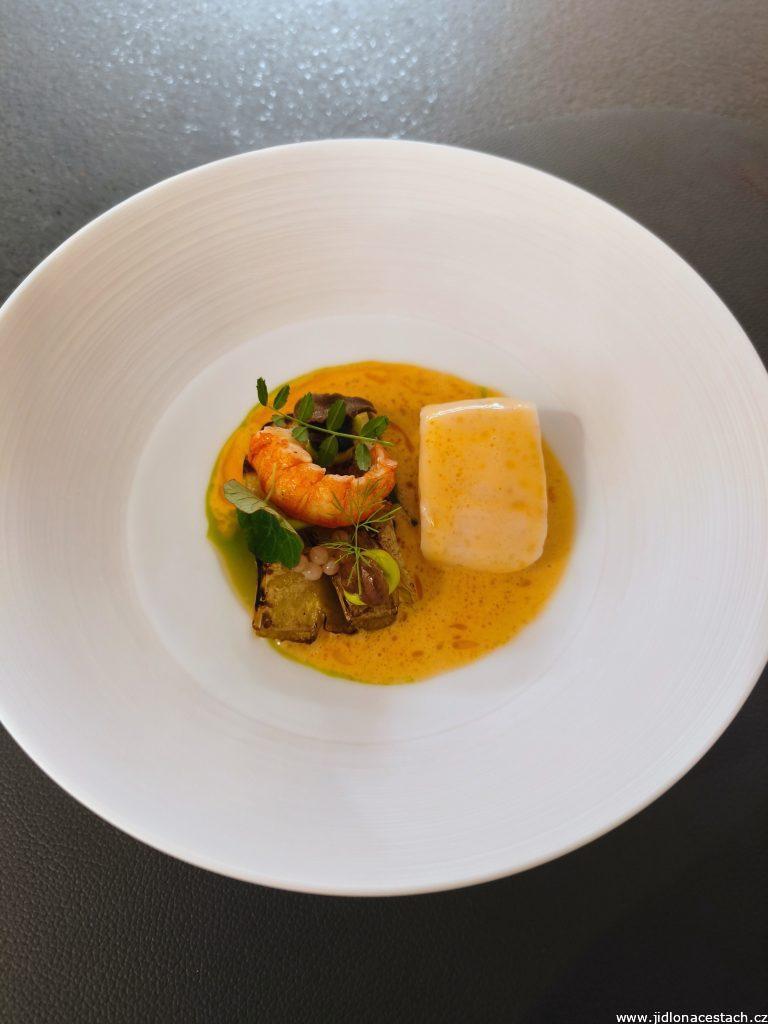
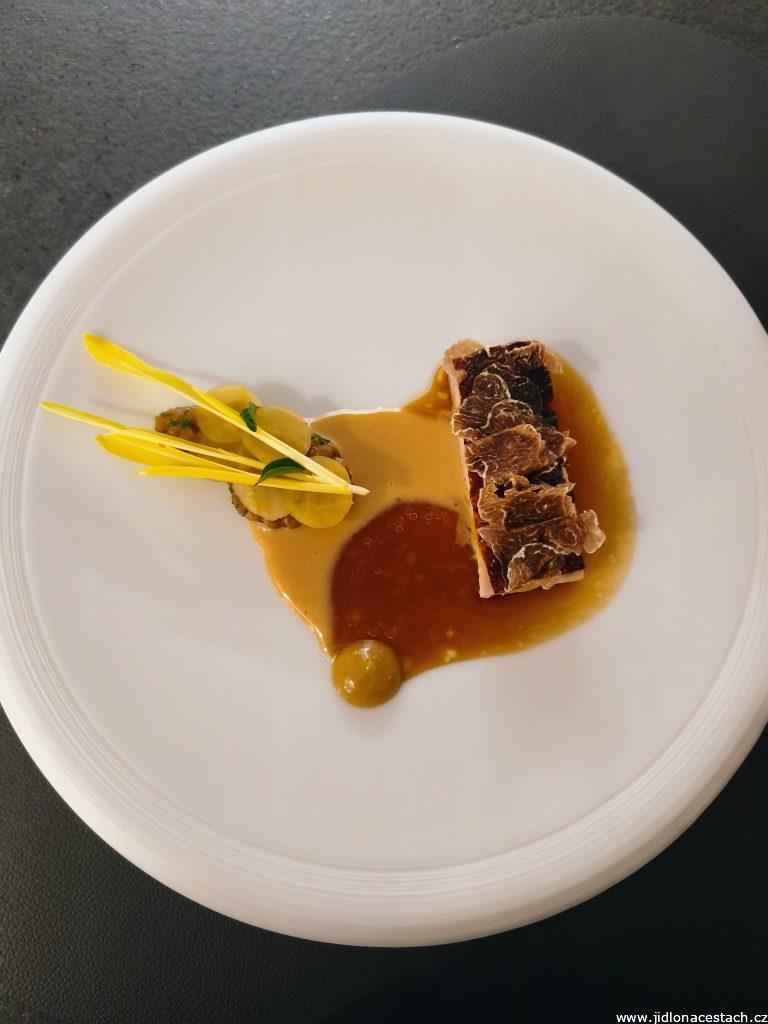
The current menu at Papilio represents the definition of uncompromising luxury regarding ingredients. Knedla serves the best and highest quality available at the moment. From caviar to crayfish to white truffles. It is gastronomy that is not afraid of opulence, but Knedla serves it with humility and technical precision.
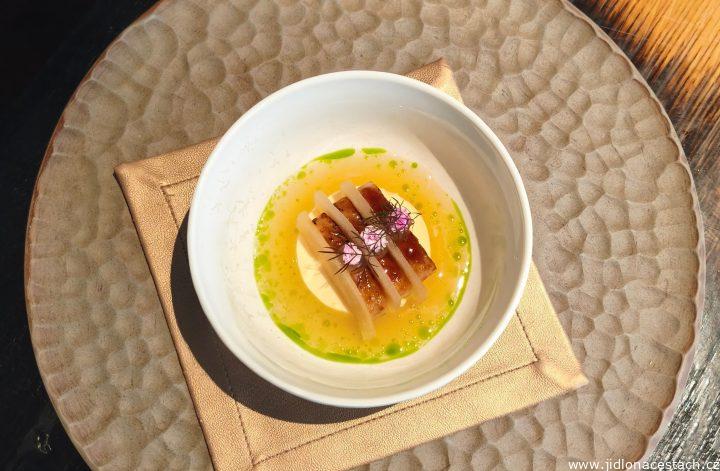
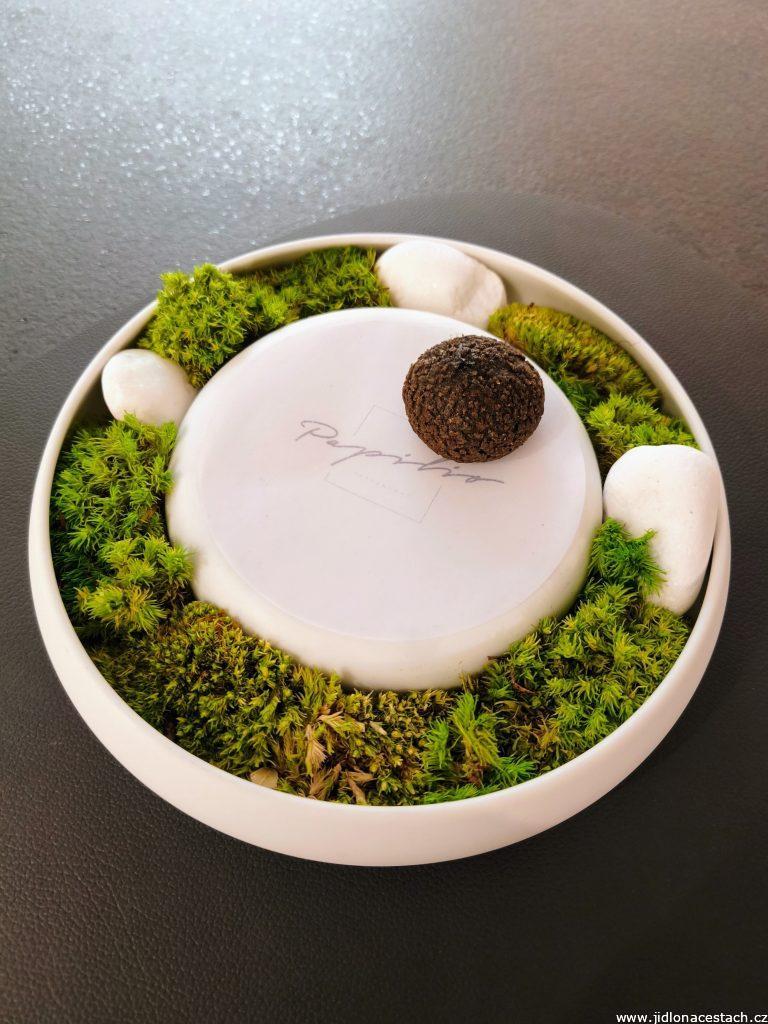
The tasting itself begins with a series of three canapés, where zander with caviar, Wagyu beef, and a false truffle play the leading role. Already here, the taste shoots to heavenly heights, and yes, it continues at a similar level until the end.
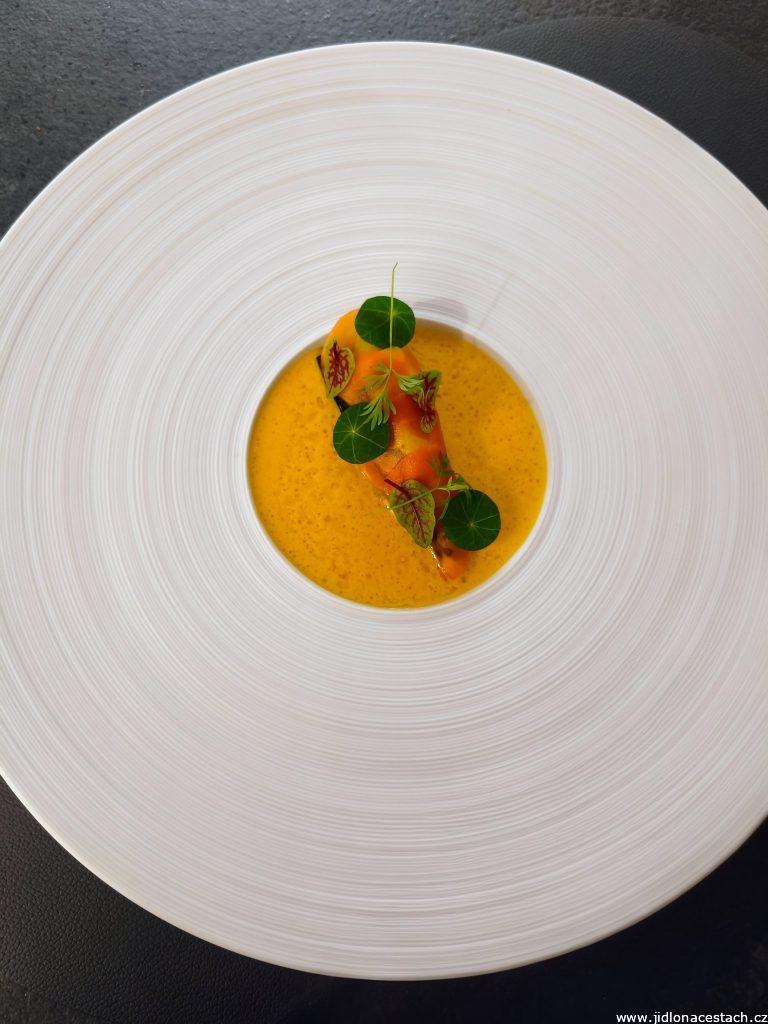
The carrot with miso, pistachios, and tarragon was the most distinctive moment of the entire dinner for me. It is not just about taste, but a visual game. On the plate before you lies a perfect illusion of an orange root, which is actually composed of many different textures and forms of this vegetable. The upper part consists of literally millimeter-thin slices, precisely assembled to shape the final silhouette.
It is a textbook example of how a chef can elevate an ordinary ingredient into an unforgettable work of art.
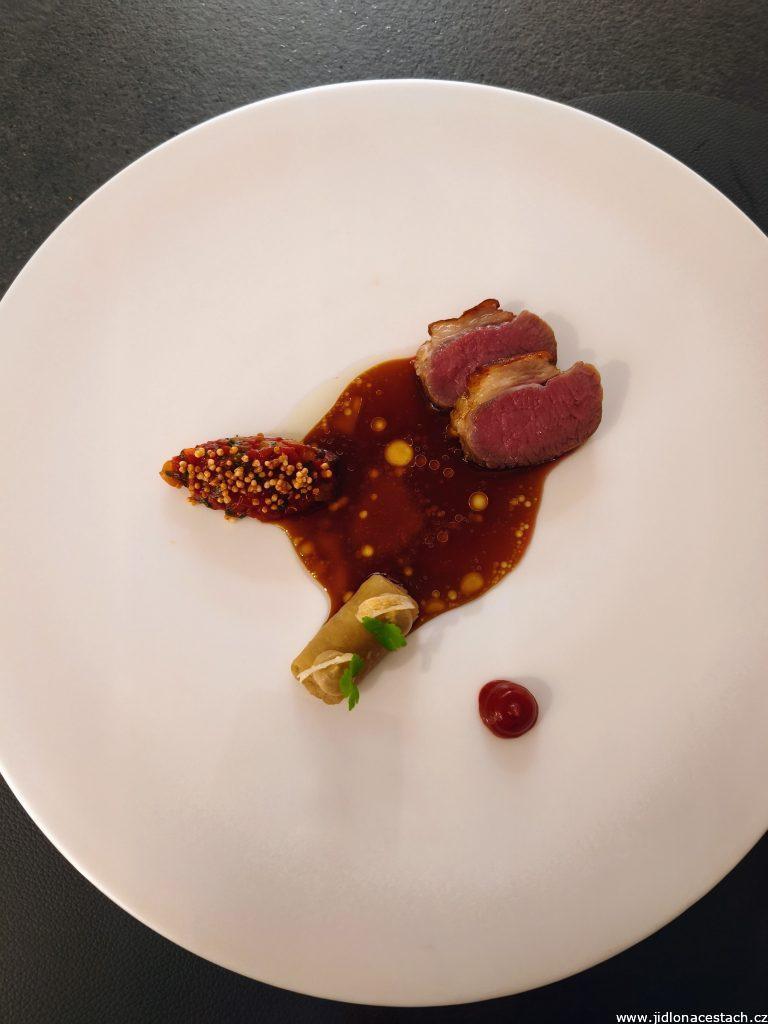
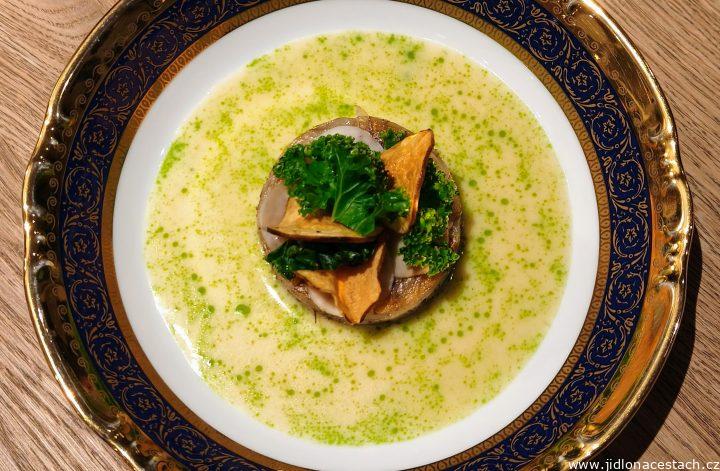
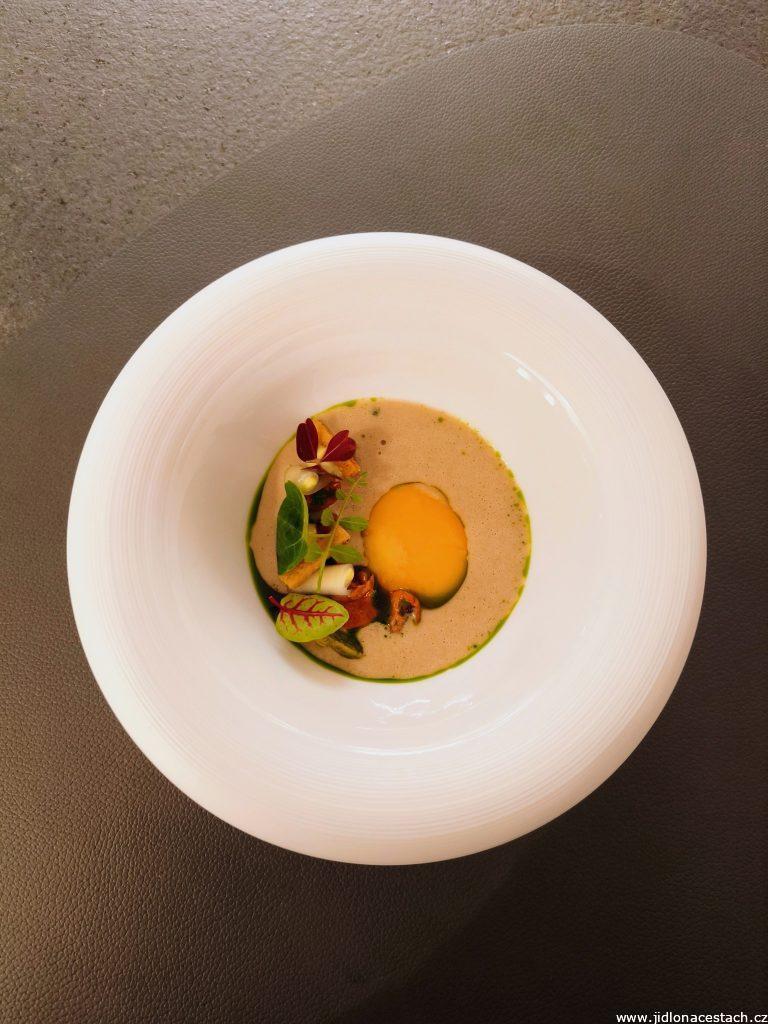
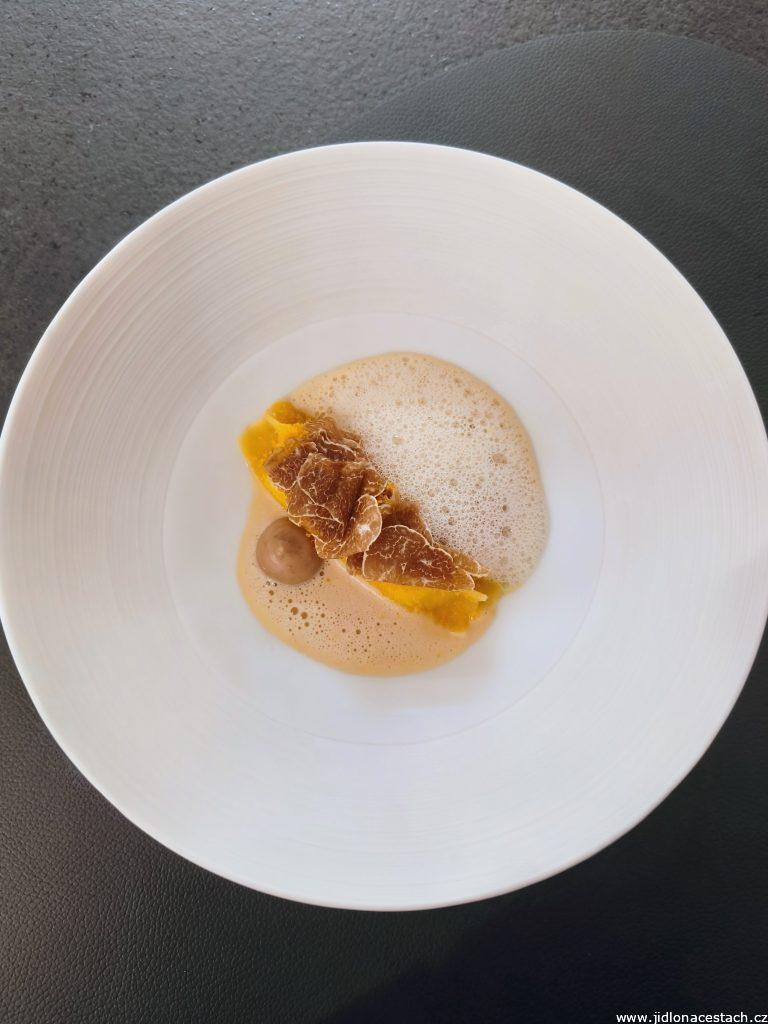
Next is the egg yolk with chanterelles and pattypan squash or the precisely processed zander with fennel, crayfish, and snails. The guinea fowl, which aged in koji, shows the technical proficiency of the kitchen; the ravioli filled with cheese and richly grated with white truffle is light as a feather. The meat section is closed by lamb with eggplant and pepper, which won me over with its wonderfully distinct, deep flavor.
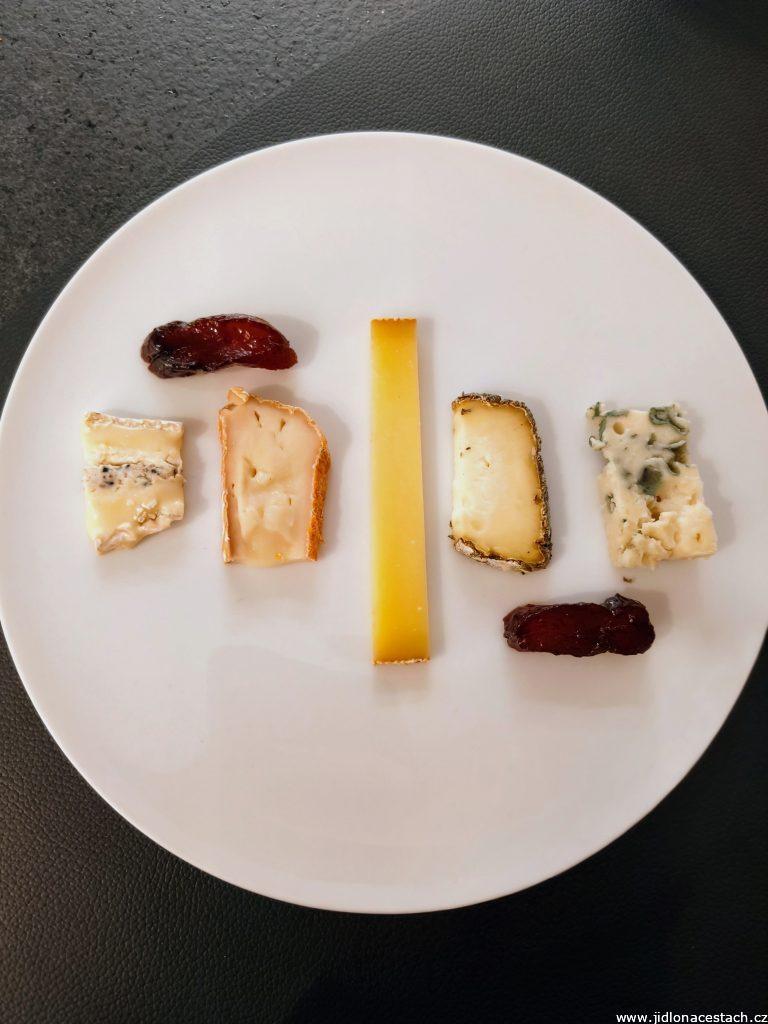
The cheese plate is well-thought-out, and the flavors again graduate gradually. The tasting begins with a mild Brie with black truffle, continues through goat Reblochon to an Alpine classic in the form of Gruyère cheese. The intensity is increased by sheep cheese aging in Provençal herbs, and everything culminates with Roquefort cheese. The cheeses are perfectly complemented by unsulphured apricots.
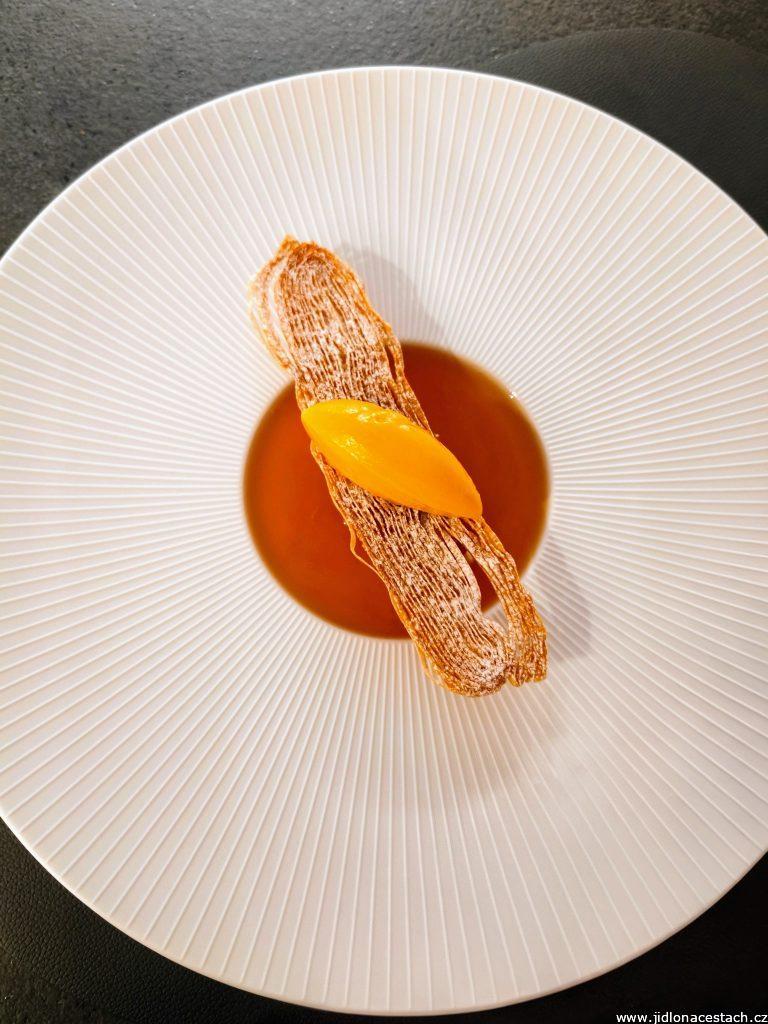
In the sweet section, do not expect heavy desserts, but rather refined plays with flavors. Sea buckthorn with anise, fennel, and ginger cleanses the palate, while the apricot with almonds, quark, and lemon balm returns the guest back to memories of a Czech summer; Knedla himself, according to his words, remembers his grandmother in it.
Papilio is a restaurant for special occasions. The basic six-course menu comes out to 3,500 CZK (140 EUR). However, most guests reportedly choose the eight-course variant for 4,500 CZK (180 EUR) or the complete ten-course tasting for 5,500 CZK (220 EUR). Papilio does not count the introductory “amuse bouche” and the final “petit fours” in the total number of courses, which is worth mentioning.
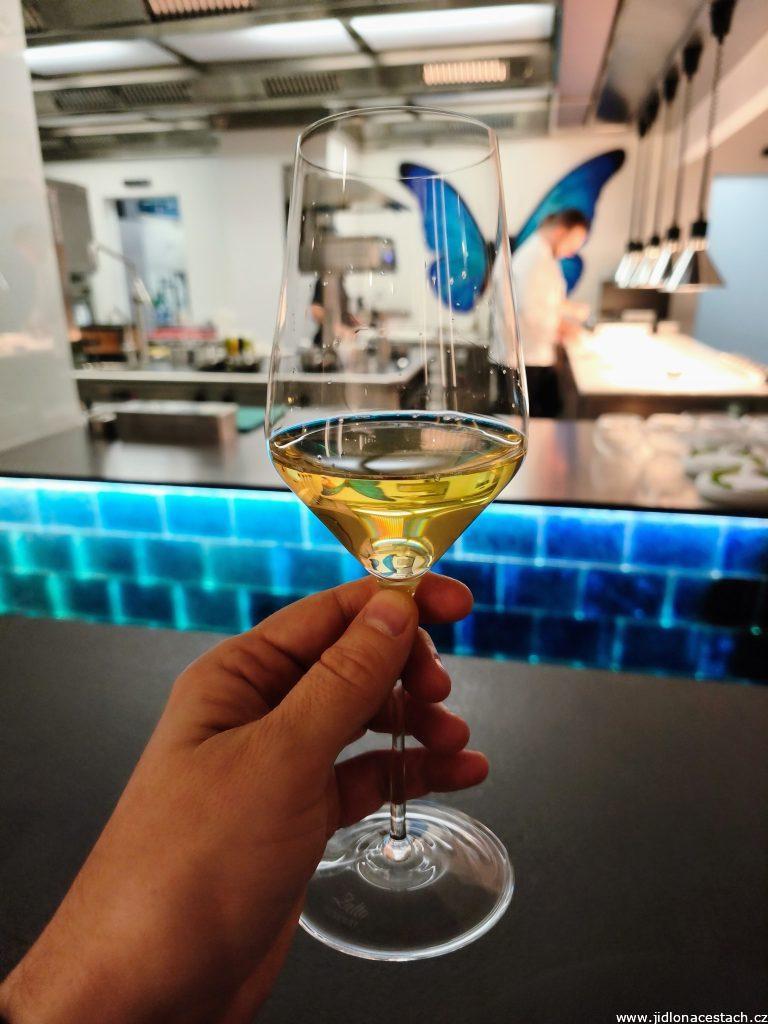
Part of the experience is, of course, the pairing. The sommelier prepared two wine variants: the basic “Privia” (from 2,000 to 3,200 CZK/from 80 to 128 EUR) depending on the number of courses) and the exclusive “Pavonia” (from 3,500 to 5,900 CZK/from 140 to 236 EUR), which includes rare vintages. For those who do not indulge in alcohol, a tea pairing (from 1,300 to 1,900 CZK/from 52 to 76 EUR) is prepared, which I tasted.
The teas are prepared in advance, carefully weighed, and served already cooled. The selection includes, for example, Chinese Bancha, South American Mate, or Indian Masala Chai. The goal is not to impress tea connoisseurs with archival harvests, but to offer clean, understandable flavors that form a reliable and unobtrusive accompaniment to the meals.
The first year of the Gault&Millau evaluation in the Czech Republic (2025) meant an immediate shoot to the very top of the national gastronomic scene for Papilio. Papilio was the only restaurant to receive the maximum number of toques. Thereby, it secured the position of the best restaurant in the Czech Republic within the ranking. Jan Knedla was awarded as Chef of the Year by the Gault&Millau guide.
What awaits Jan Knedla and Papilio next? Ambitions can be felt in the air, even if the chef speaks about them with humility. Papilio has all the parameters to aspire to a high award even within the new Czech Michelin guide; these will be awarded as early as tomorrow. Knedla’s kitchen bears comparison with the European elite.
The only question is probably whether the two-star award will come this year, or if Knedla and his team will work their way up to it next year.
Papilio indeed has the best prerequisites for ⭐⭐.
11 December 2025: Under the leadership of Jan Knedla, Papilio became the first Czech restaurant to be awarded two Michelin stars!
Restaurant website: restaurant-papilio.cz
🇨🇿 You have mastered Czech cuisine. How about trying something new? Sign up for my newsletter and I will introduce you for free to great dishes from Spain, Portugal, or France.