Tea is, without exaggeration, a central element of social life in Iraq. Tea consumption in Iraq goes beyond ordinary dietary habits and becomes a ritual that accompanies the inhabitants from the morning hours until late at evening. The specific taste, method of preparation, and serving slightly distinguish Iraqi tea from variants in neighboring countries.
Tea in Iraq
Origin and History of Tea in Iraq
The history of tea consumption in Iraq is relatively young compared to other regions of Asia. While coffee dominated the Arab world for centuries, tea began to spread massively only during the 19th and early 20th centuries. A key role in this process was played by the British presence in the region and trade relations with India and Ceylon (today’s Sri Lanka). The British, who controlled the trade routes, began importing tea to the port of Basra in the south of the country. From there, this beverage quickly spread to Baghdad and other provinces. Iraqis quickly adopted this new drink and adapted it to their taste preferences. Today, Iraq is one of the largest importers of tea in the world, with most of the raw material coming from Sri Lanka.

Preparation Method and Specifics
The preparation of Iraqi tea is carried out using a method that ensures its characteristic strength and aroma. Unlike the common pouring of hot water over tea leaves in a single step, Iraqis often use a double boiling method, similar to Turkey or Iran, but with certain differences. The basis is the use of loose-leaf black tea, often the Ceylon variety. Tea is prepared using two kettles, often stacked on top of each other (the so-called samovar principle), or a strong concentrate is boiled directly on a heat source.

The process begins by boiling water in the lower, larger kettle. A large amount of tea leaves is poured into the smaller kettle, and several cardamom pods are added. Cardamom is an absolutely key ingredient for Iraqi tea and gives it an unmistakable aroma. For me, however, cardamom in Iraqi tea is not distinctly noticeable, which I greatly appreciate. Cardamom is used whole or crushed and only slightly changes the taste and smell (for me, it tastes like rose). The leaves with cardamom are poured over with boiling water and left to steep on low heat, often placed on top of the lower kettle to keep warm but not to boil at a rolling boil. The result is a very strong, dark, and bitter concentrate.
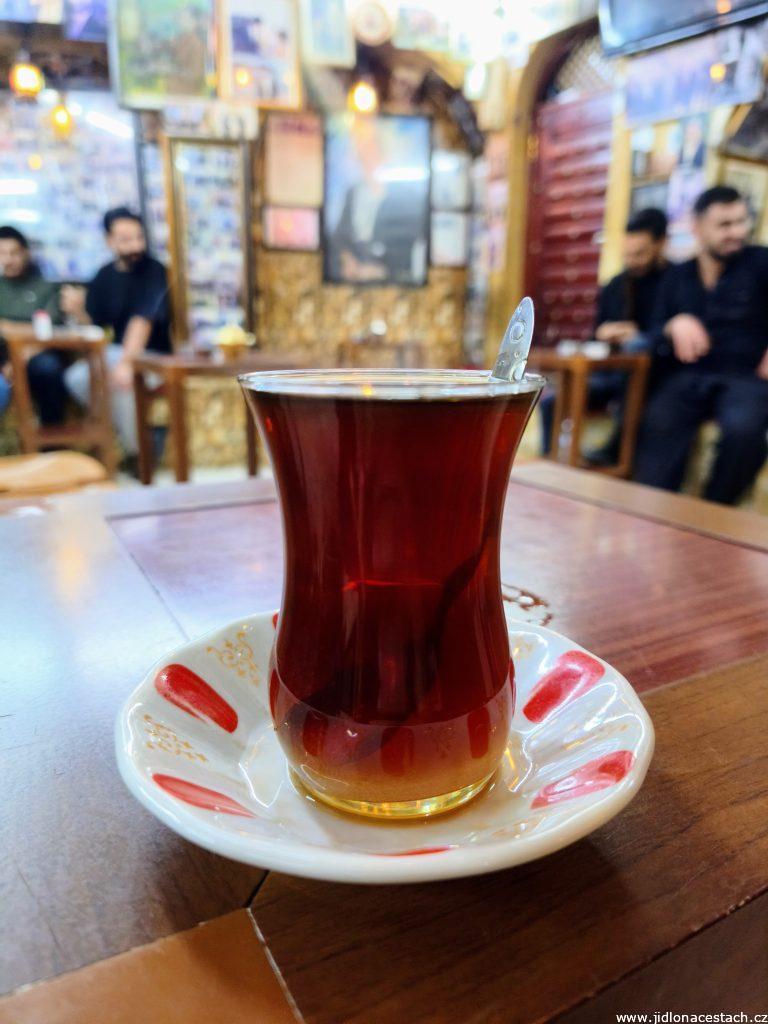
When serving, a portion of this concentrate is poured into a small glass, called an istikan, and topped up with hot water according to the guest’s taste. However, this is not always the case; it is also possible to encounter tea prepared in a single kettle.

A crucial step is sweetening. Iraqi tea is sweetened with a huge amount of sugar. Sugar is added either directly into the kettle during boiling or, more often, directly into the glass before pouring the tea. The amount of sugar is so large that it often does not melt and forms a visible layer at the bottom of the glass. This extreme sweetness balances the natural bitterness of the strong black tea and tannins. For many visitors from Western countries, this level of sweetness can be surprising, and even for me, Iraqi tea is the sweetest I have ever tasted.

Comparison With Turkey and Iran
Iraqi tea fulfills a similar social function as tea in Turkey or Iran, but there are subtle nuances. In Turkey, tea is served without flavors, plain. Iranian tea culture often involves drinking tea through a sugar cube held in the mouth. Iraqi tea is specific precisely for the inclusion of cardamom directly in the steeping process and the extreme amount of sugar.
The social importance of tea in Iraq is enormous. Refusing an offered cup of tea can be perceived by the host as an insult or a sign of impoliteness. “Chaikhana” teahouses are traditionally the domain of men, where politics, business, and daily life are discussed. In households, women prepare tea for the family and guests after every meal and during every visit.
The Istikan Glass
An integral part of the experience of drinking Iraqi tea is the “istikan” glass in which it is served. This term has an interesting etymology. One theory claims that the word comes from the English “East Tea Can”, which was used by British soldiers, but linguists lean more towards the opinion that the word has roots in Russian (stakan – glass) or Persian. The istikan has a specific shape with a narrowed waist, which helps keep the beverage hot while allowing for a comfortable grip by the upper rim. The glass is always served on a small saucer, often with a small spoon that makes a characteristic tinkling sound against the walls of the glass when stirring sugar. This sound is ubiquitous in Iraqi teahouses.

I like to devote a lot of time to sipping tea in countries such as Iraq, Iran, or Turkey. Truth be told, for me, it is one of the most pleasant activities while traveling. It is enough to sit in one of the street teahouses, order tea, and observe the surrounding events. One relaxes with it, reliably establishes contact with locals—even without knowing the language—and does not have to rush anywhere. For me, drinking tea represents the ideal way to get to know the atmosphere of a country from a slightly different perspective.
One glass of tea costs 250 IQD (0.15 EUR) in Iraq, and double that, 500 IQD (0.30 EUR), in renowned teahouses.
So, cheers!