Strada delle Orecchiette: The Bari Alley Where Women Make Pasta
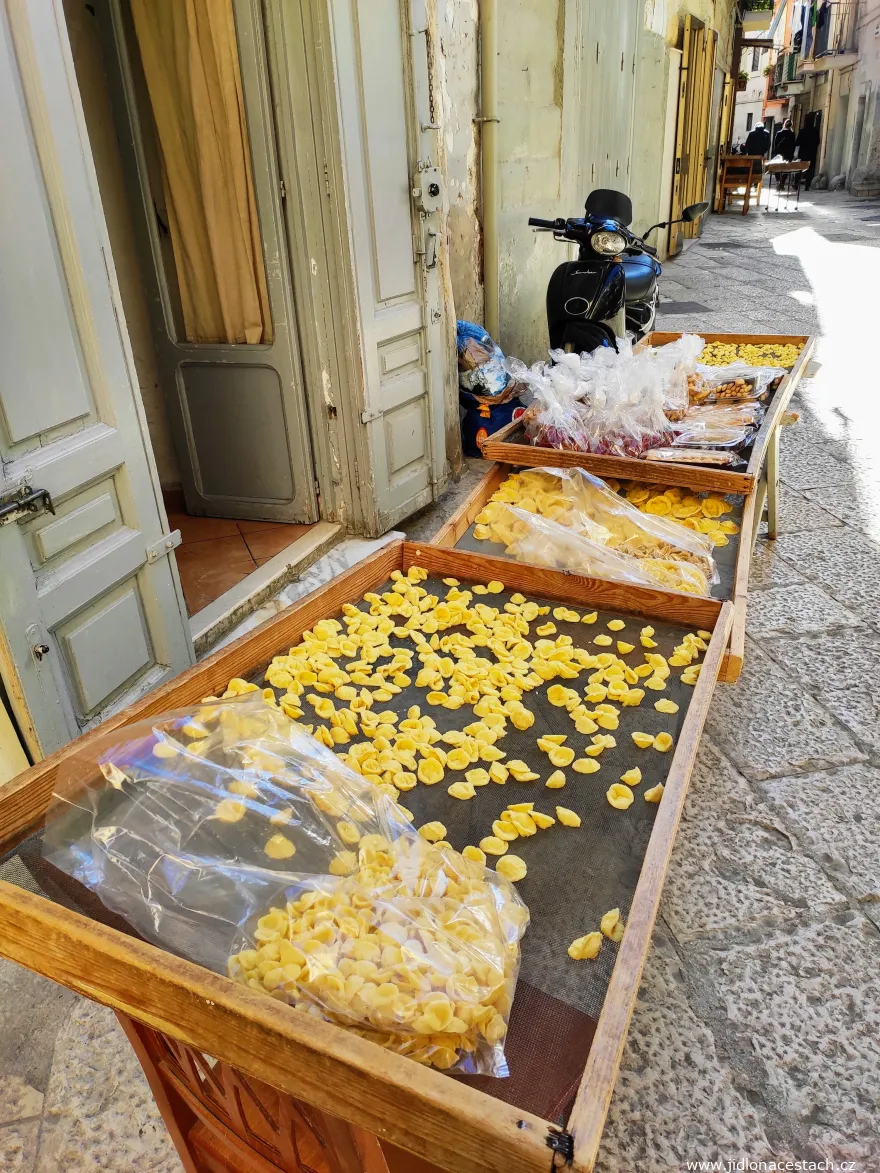
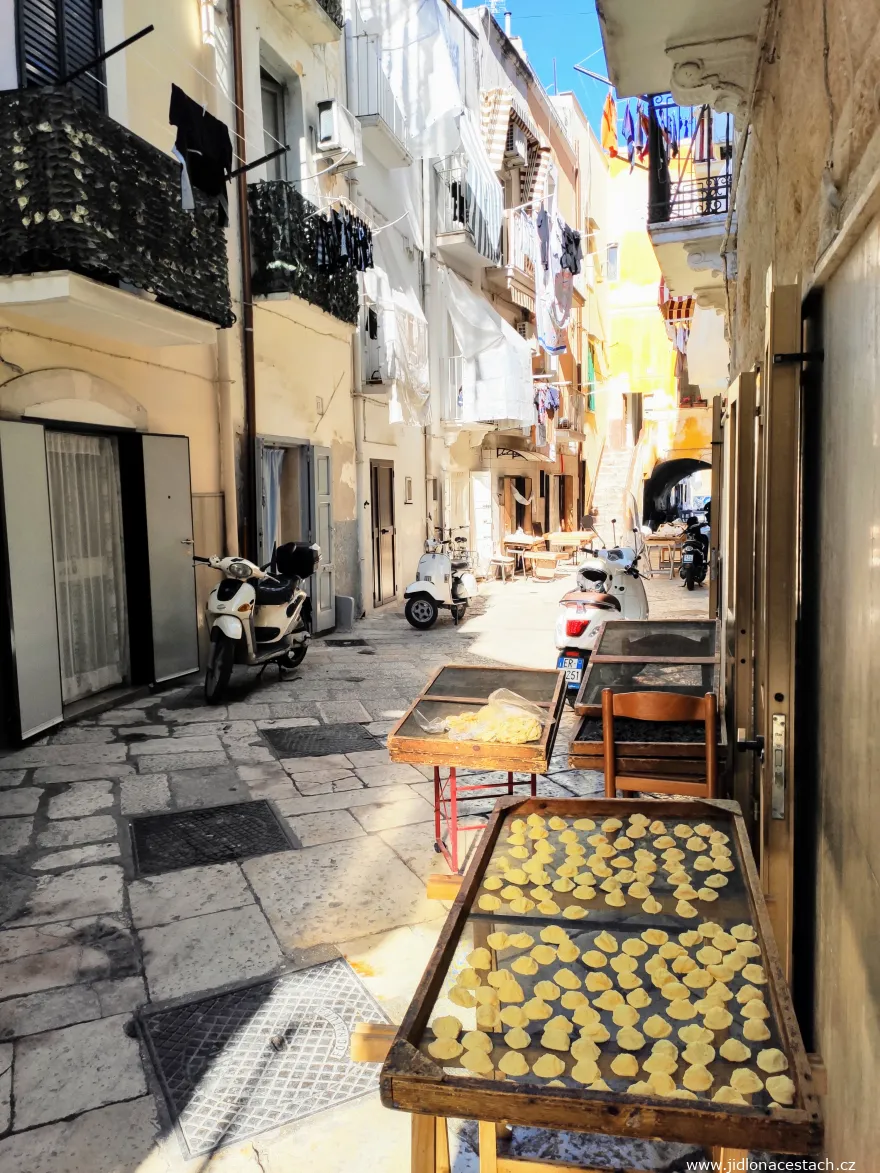
You won't find any Strada delle Orecchiette on a map of Bari. It exists only in guidebooks and on Instagram. And yet every morning anyone who turns off by the castle into the old town finds it: women sit in a doorway or in a kitchen you can see into from the street, drag a knife across lumps of dough on a board, flip them inside out over a fingertip and tip the finished little ears onto wooden racks by the door. All the while they chat away and smile at the curious visitors who stop at the racks.
Strada delle Orecchiette is the nickname of Strada Arco Basso in Bari Vecchia, where local women make and sell fresh orecchiette right outside their own homes - pasta ears of durum wheat and water, Apulia's best-known contribution to Italian cuisine. There is more on the racks than the name suggests.
The Alley That Was Named After Shoemakers
Officially the alley takes its name from the low arch you pass under coming from Castello Svevo, and before that it was called strada degli zoccolari, the clog makers' alley, because this is where the shoemakers used to sit. The pasta name didn't come from any city office - the tourists gave it, and the pasta itself is named after ears: orecchiette is the diminutive of orecchio, literally little ears. The ears themselves are a local dish, part of Bari and Apulia, even though Barilla now sells them in every Italian supermarket. Southern Italy has a whole family of finger-shaped pasta: Basilicata makes the longer strascinati, Molise cavatelli with a lengthwise groove instead of a hollow, and Sardinia ridged malloreddus, which are shaped not with a thumb but by dragging them across a wicker basket. I don't know of another street, though, where any of them get shaped out in the open on the sidewalk.
Who Came First on Arco Basso
Two legends compete over where the ears came from: one has the Angevins bringing them to Apulia from Provence in the Middle Ages, the other has them born in nearby Sannicandro di Bari, in the Jewish community there, as "Haman's ears". Neither can be proven. The one hard fact sits in the archive of the Basilica of Saint Nicholas: a document in which a master pasta maker leaves the craft of making the ears to his daughter as her dowry, and Italian websites can't even agree whether it dates from 1500 or 1596, which tells you everything about how reliable the legends are. Nobody puts a date on the alley itself; the oldest of the women, Franca Fiore, says she was the first to sell ears here, and her daughter Nunzia Caputo is the best-known face of the street today: she represented Bari in New York, and in 2022 Stanley Tucci turned up with a camera crew to film an episode of his series about Italian food. Selling used to be a Sunday affair. It only turned into a daily job once the tourists came, and there is no shortage of them in a quarter with barely six thousand residents and almost nine hundred guesthouses.
Semola, Hot Water and Two Index Fingers
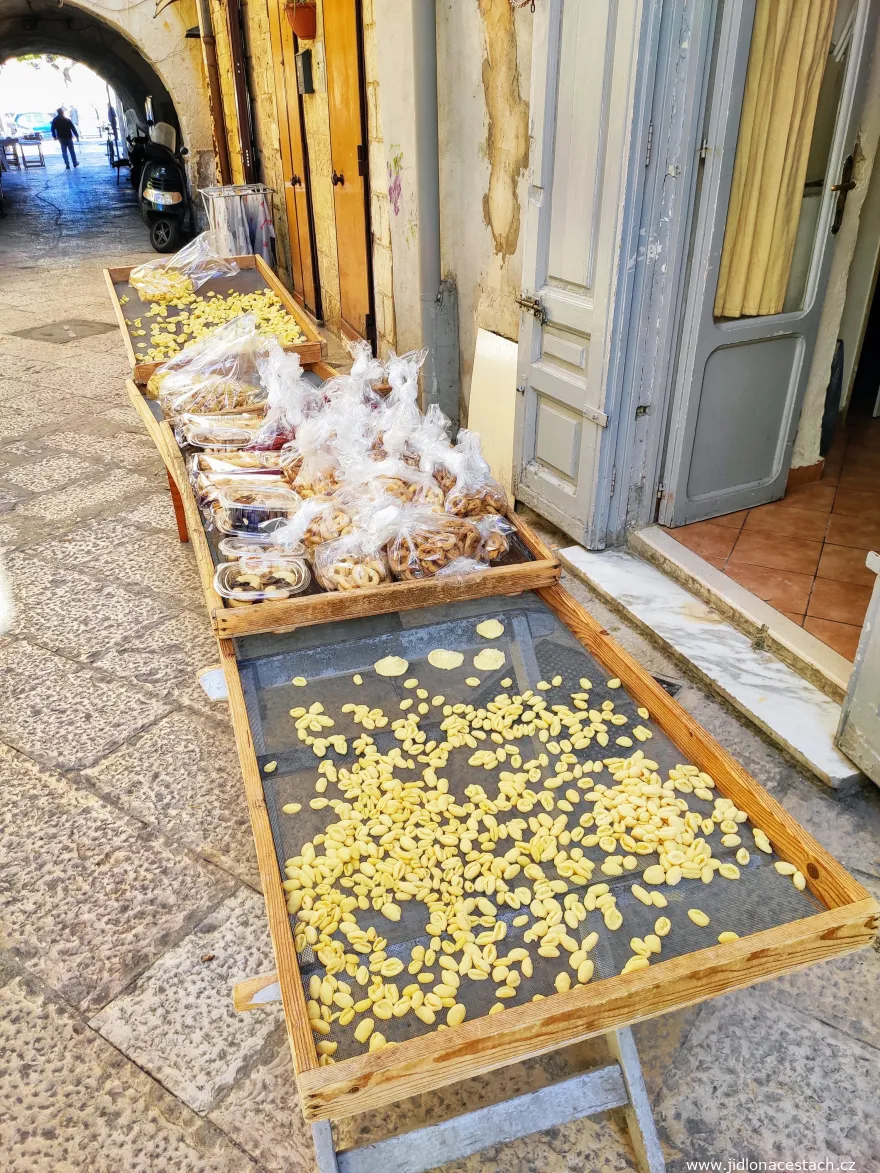
The dough is as humble as southern cooking as a whole: durum wheat semola, hot water and salt, no egg. All the skill is in the hands: the knife cuts a piece off the rope of dough, a drag along the board flattens it and a finger turns it inside out, leaving a little cup with a rough surface that holds sauce better than any shape out of a machine. The finished ears go onto wooden frames called telaio and dry in the open air right there in the alley, the way we dry mushrooms on a screen on the windowsill back home, only with an audience. Next to the ears in three sizes you'll find cavatelli, crunchy rings of taralli, sweet cartellate and newer colored versions of the dough with spinach or squid ink.
The alley comes alive in the morning, roughly from eight until noon, every day of the year; the Sunday classic in Bari is ears with cime di rapa, a bitter leafy brassica, anchovies, garlic and chili.
Watch the hands, though, not just the bags: in February 2025 the prosecutor's office in Bari opened an investigation into suspicions that factory-made ears were being sold at the racks as homemade; four of the women were fined 5,000 EUR, and in June the city issued rules: shaping in front of customers is allowed, selling packaged pasta from a factory is not. If you want to be sure, buy what you can see being made.
A Morning on Arco Basso
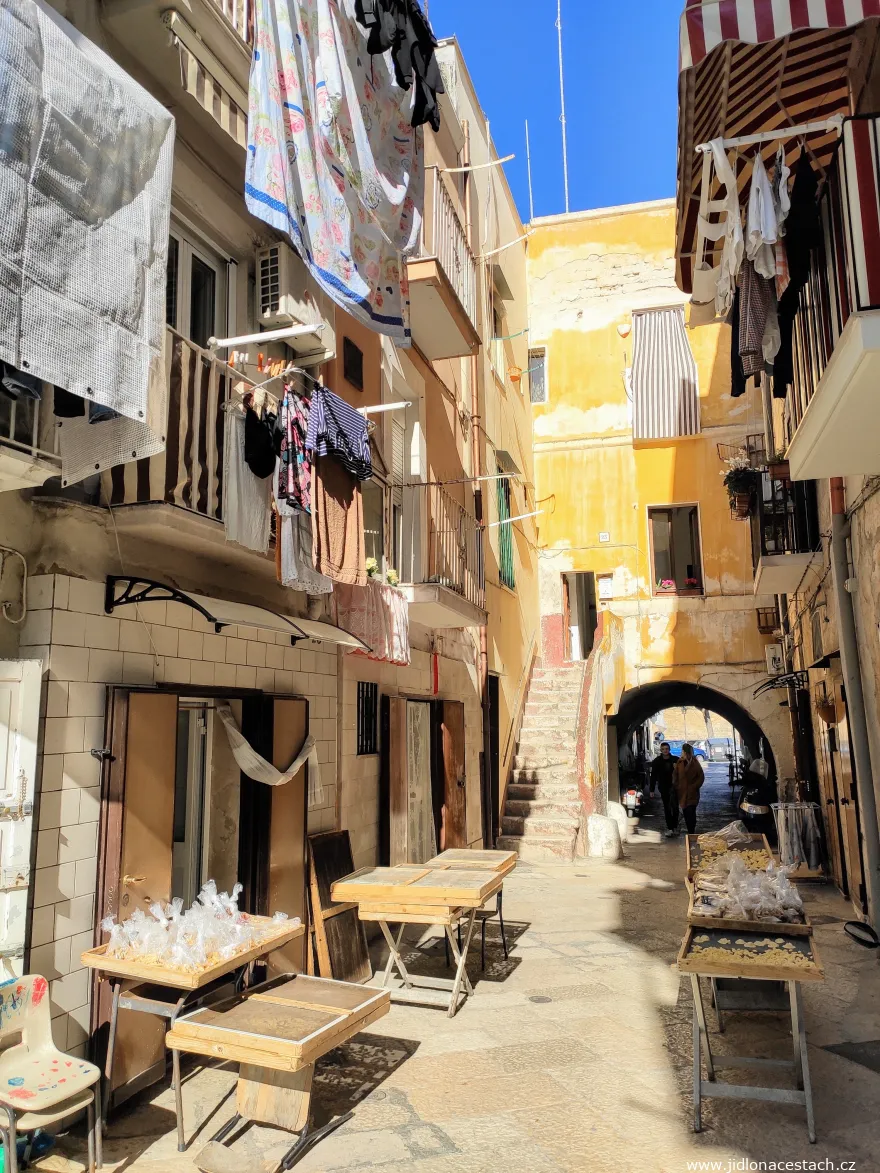
I walked into the alley in the morning from the castle like most sightseers, and that's all I stayed: I walked the whole length of it, looked into the kitchens you can see into from the street, and bought nothing. Fresh pasta that has to be cooked by evening is a bad souvenir for a man with a backpack and no stove. The price was low, so low it never stuck in my memory. If you have a stove where you're staying, take the ears with you and pick up a focaccia barese at the bakery to go with them; if you don't, do what I did and walk a few hundred meters on to Antica Gelateria Gentile for ice cream. Until the end of the nineties Bari Vecchia was considered one of the most dangerous parts of the city. Today there is no avoiding it, because you're standing in line for a photo in front of somebody else's kitchen. And the women at the racks do what they have always done: open the door, carry out the racks and smile at the next batch of curious visitors.
Strada delle Orecchiette


