Les Halles in Clisson: A Wooden Market Hall from the 14th Century
I went to Clisson for the town itself: the castle above the river and the views down the valley. But the oldest thing I had almost to myself that morning wasn't made of stone. It was made of wood.
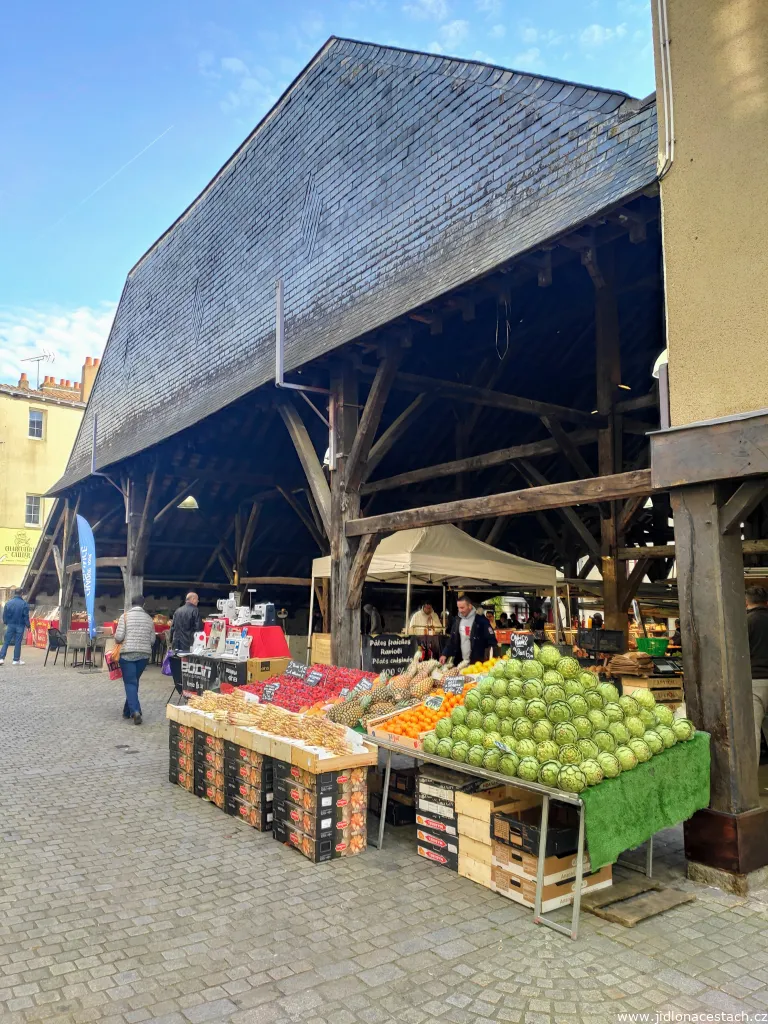
Les Halles in Clisson is a covered wooden market hall built in 1376 and 1377, one of the oldest in France - markets have been held under its roof frame without a break for more than six hundred years. This is no open-air museum: twice a week, vegetables, cheese and fish still change hands under the medieval beams, exactly as they did when the hall was new.

The Market Hall That a Tax Built
The hall has about the plainest name it could have: les halles is simply French for a covered market, and hundreds of buildings around the country go by it, the famous Paris one included. The square it stands on gives away more - place du Minage is named after the minage, a medieval tax on grain sold at market, measured out in units called mine. Those fees are exactly why the lords of Clisson put the hall up at the end of the 14th century: a market under their own roof, a few steps from their own castle, meant reliable income. Just how old the timber is only came to light in 2016, when dendrochronologists counted the tree rings: the oak, chestnut and fir that went into the roof frame were felled in 1376 and 1377 - more than a century before Columbus set sail for America.

How a Wooden Hall Survived the Burning of the Town
You can't take it for granted that a wooden building will last six and a half centuries - and in Clisson least of all. During the War in the Vendée, General Kléber had the town burned in reprisal in 1793; it burned for ten days, and whatever was left was finished off a year later by the republican "infernal columns". The market hall, on paper the most flammable building in town, came through the destruction almost untouched: both warring armies used it as shelter and camp, and the republican soldiers fought back the very fires they had started, to keep them from reaching it. So the two sides of the civil war agreed on exactly one thing: everybody can use a roof over their head.
The town standing around the hall today is younger than the hall itself. Clisson had been emptied of people, and after 1798 the Cacault brothers from Nantes rebuilt it together with the sculptor Lemot; both had come back from Italy, so they built it Tuscan style: thin bricks, arches, barrel tiles. The "little Italian town" that fills the postcards today is a reconstruction born from the ashes - only two originals were left, the castle and the market hall. The hall is the oldest of the four wooden market halls surviving in historic Brittany; Questembert, the one people talk about most, is nearly two hundred years younger.
Market on Tuesday, Market on Friday, Vineyards on the Doorstep
The market has two rhythms. On Tuesday morning the selling stays under the hall and the whole thing is an intimate affair; on Friday the market spills out of the hall into the surrounding streets with around a hundred traders. The stalls are piled with fresh bread and pastries, ripening cheeses, seasonal vegetables and fish from the Loire. What farmers' markets back home had to bring back to the squares never went away here in the first place. And if you lift your eyes from the stalls to the hills behind the town, you are looking at vineyards: Clisson is one of the communes allowed to put its own name on the label within the Muscadet Sèvre-et-Maine appellation. The light white wine that goes with fish comes from vines right on the doorstep.
Clisson itself is worth lingering in once the shopping is done. The castle was the seat of a family whose most famous son, Olivier de Clisson, made it all the way to Constable of France and to the nickname The Butcher; below the walls the river Sèvre Nantaise breaks over a weir, and from up high the town falls into a view worth getting off the train for. Direct trains run here from Nantes roughly fifteen times a day and the ride takes fifteen minutes. Once a year the quiet town of seven thousand is turned upside down: the Hellfest metal festival draws more than 240,000 people, over thirty times the population of Clisson. The rest of the year the town belongs to market traders, wine and day trippers.

A Morning in the Empty Hall
That is exactly how I came to Clisson, by train from Nantes for a half-day trip - and the market hall was as much a part of the town as the castle. I got there early in the morning, when the hall was still almost empty, and for a while I just stood under the beams and watched the market slowly get going. The traders were friendly even to a visitor doing more looking than buying; at the cheese and bread stalls they handed out little samples to taste, and their prices were the same as anywhere else in France. What stays with you is a simple thought: the spot is the same, the building is the same, the sellers and the produce are the same as they were six hundred years ago - only the wicker baskets and straw have given way to cardboard and plastic crates. Six centuries show mainly in the packaging.


