Jaffa Oranges: The Shamouti Variety from Jaffa's Orchards and an Export Brand
The British know it from the orange jelly biscuits they've been baking since 1927, the Finns from a soft drink, and half the Balkans from Serbian cookies. The name Jaffa has travelled around the world so many times that the fruit it's all named after got left behind somewhere along the way.
Jaffa oranges (Hebrew: תפוזי יפו) are the Shamouti variety: a sweet, oval-shaped orange with a thick but easy-to-peel rind and almost no seeds, which appeared in one of the orchards near the port of Jaffa in the mid-19th century and became the most famous fruit of Israeli cuisine before Israel itself even existed.

What Jaffa Means, and Why Spanish Oranges Carry It Too
The fruit got its name from the port its crates sailed out of, bound for Liverpool. Hebrew then coined its own word for the orange: tapuz is a shortening of tapuach zahav, golden apple, which one linguist proposed in the 1930s should be read as an ordinary word - and people obliged so thoroughly that hardly anyone today realises they're pronouncing an abbreviation. Jaffa today, though, isn't a variety but a brand: a geographical designation protected by Israeli law, under which dozens of citrus varieties are sold, and which the Citrus Marketing Board of Israel licenses for a fee to growers in Spain and South Africa, so the label doesn't disappear from European shelves in the months when Israel isn't harvesting. An orange wearing the Jaffa label, then, need never have seen Jaffa. The Shamouti itself is a mutation of an older local variety, beledi, and has relatives all across the eastern Mediterranean: in southern Lebanon and on the Palestinian West Bank it's still called burtuqal Yafa in Arabic, the Jaffa orange, while Egypt, today the world's largest orange exporter, tends to grow varieties with a different rind and different juice.
Jaffa's Orchards: From a Swedish Botanist to the Chainsaw
The first person to record the Jaffa orange was the Swedish botanist Fredrik Hasselquist, who stopped in Jaffa around 1751. By 1900, some 650,000 crates a year were shipping out of the port, and the orchards, bajarat in Arabic, covered a third of the region's farmland. Most belonged to Arab growers, with some held by Jewish settlers - for a long time, the harvest was one of the few things the two communities did together. During the 1948 war, most of the Arab growers fled or were expelled, and their orchards were taken over by the Israeli state as so-called absentee property; ever since, the Jaffa orange has been a national brand for one side and a reminder of a lost home for the other - a theme explored in Ghassan Kanafani's short story The Land of Sad Oranges and Eyal Sivan's documentary Jaffa, the Orange's Clockwork.
A Rind Like a Coat: Why the Shamouti Survived the Voyage by Ship, and Why It's No Good for Juice
The main curiosity of the Jaffa orange is its rind: thick, coarse, and yet it peels off almost in one piece, like a glove. Underneath is flesh sweeter than an ordinary orange's, with a handful of seeds or none at all - and strikingly little juice. The very trait that would sink it at a juice factory is what sent it to Europe in the 19th century: a thick-skinned, drier fruit survived weeks in a ship's hold. Anyone who's ever peeled an orange with their fingernails at school and splashed juice over a classmate's exercise book will appreciate that the Shamouti is an orange you can eat in a white shirt. It's harvested from November to June; one note on the label: in summer, an orange stamped Jaffa is almost certainly from Spain or South Africa - look for the Israeli Shamouti in winter.
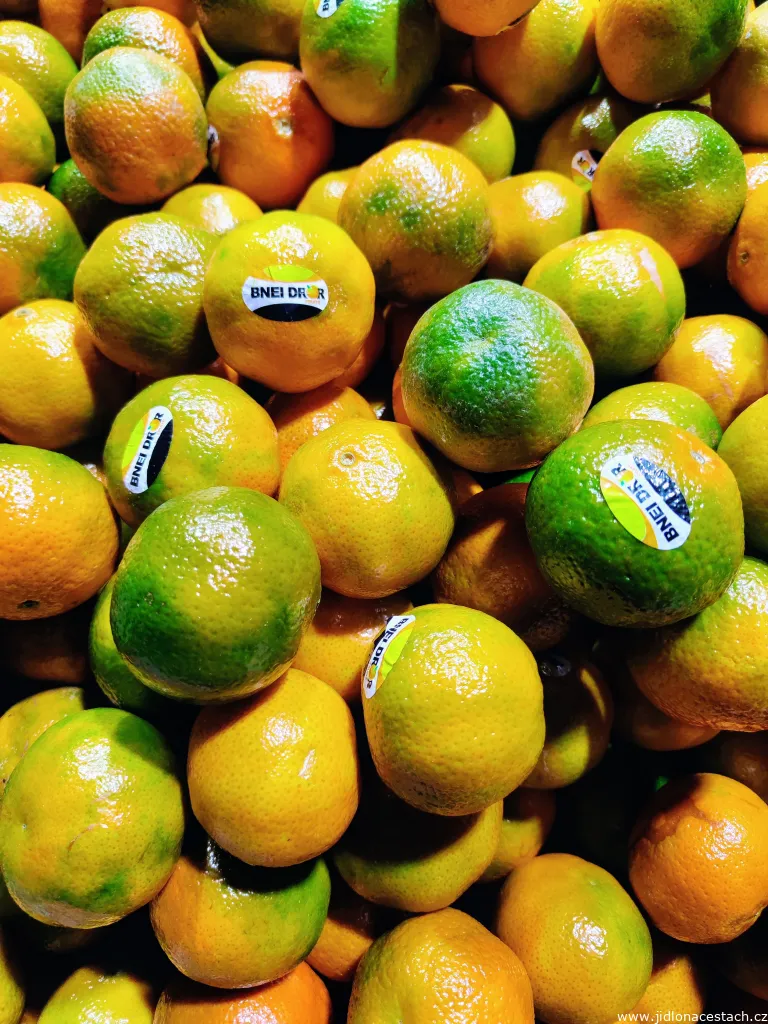
Two Oranges and Two Mandarins from the Damascus Gate
I bought my Jaffa oranges in Jerusalem, at the market in front of the Damascus Gate (see Where to Eat in Jerusalem), where fruit and vegetables are sold right on the street beneath the walls. Two large oranges and two mandarins came to 4 ILS (1.20 EUR) together. The rind had a paler, yellow-orange shade than the oranges from our supermarkets and came off almost by itself; the flesh was sweet, with no seeds at all - exactly as the variety's description promises. The mandarins carried a Bnei Dror label, from the moshav on the Sharon Plain that switched to citrus in the 1960s, and were the one thing in the whole purchase that didn't win me over on taste. I didn't eat the orange until I reached the shore of the Dead Sea: a fruit whose ancestors once travelled from Jaffa to Liverpool ended up covering its last few kilometres with me, at the lowest point of dry land on Earth.


