Halva: The Crumbly Sesame Sweet of the Eastern Mediterranean
At the market, halva is sold by the kilo. The signs propped against the blocks give a price per kilogram, the vendor carves slices off a brick the size of a loaf of bread, and the scales have the final say. Except that nobody eats a kilo of halva in one go; it's a sweet you buy by the kilo and eat by the slice, ideally thin and with coffee.
Halva (Hebrew: חלווה) is a firm, crumbly confection of ground sesame and sugar - not an invention of Israeli cuisine, but something you'll find cut from blocks in every market there - plain, with pistachios, with cocoa, with coffee and in dozens of other flavors.
One Word, Many Sweets
The name gives away less than you'd expect. The Arabic halwa simply means sweet, and the full name of the sesame version is halawa tahiniya, the sweet made from tahini. One word covers a whole family of sweets that share nothing but that name and a firm texture. Sesame halva belongs to the whole eastern Mediterranean: in Palestine its capital is Nablus, whose mills have been grinding tahini for more than a hundred years, in Turkish cuisine it goes by tahin helvası and is considered a national sweet, though anyone who just asks for "helva" there is more likely to get the warm semolina irmik helvası, related to the sesame kind in name only. In Greek cuisine, sesame halva is "Macedonian" - not for where it came from, but for the region where refugees from Asia Minor brought it in 1922. The sunflower halva on the shelves back home in Czechia is an Eastern European stand-in for expensive imported sesame, and the Iranian halva zard is a saffron pudding that never shares a plate with the sesame block.
Four Diasporas and a 180-Square-Meter Workshop
Who invented sesame halva is something even the Hebrew Wikipedia won't tell you; sesame has been pressed in the Levant for thousands of years and nobody has put a date on the first block. The Israeli chapter, on the other hand, is short and precise. In 1929, immigrants from Turkey, Poland, Greece and Russia rented a workshop of a hundred and eighty square meters in Tel Aviv and started mixing tahini and halva in it; they named the company Achva, meaning brotherhood. Four diasporas agreed on a single recipe and the agreement has held ever since, which in this part of the world is a feat in itself. There is no honey in the blocks that leave the workshop - sugar or glucose syrup is the standard, and honey remains the exception in home recipes.
The Sugar That Learned to Spin Threads
There are two ingredients and both are ordinary: tahini, the smooth paste of roasted sesame, and sugar syrup cooked to roughly 120 degrees Celsius. It all comes down to the cooling. Sugar dispersed in sesame fat recrystallizes, and instead of a hard brick you get a mass of fine threads that crumbles under the knife and dissolves on the tongue. The closest thing to it is fairground cotton candy, if someone pressed it into a block and worked sesame through it. Turkish producers also add a decoction of soapwort root to make the mixture foam up. The machine I took for a halva press at the Jerusalem market turned out to be a mill: sesame is ground on stones here, and at the best-known stall it is shipped in all the way from Ethiopia. There'd be nothing for a press to do here: halva is stirred until it sets.
You eat it in small amounts and without cutlery: a slice with coffee, a cube at breakfast, and in shops it's sold in wrapped bars, like granola bars, so it travels in your pocket like chocolate. It isn't tied to any holiday; it's an everyday sweet. What sets the market kind apart from the packaged one is that it's freshly made and cut to order - and the Halva Kingdom stall at the Machaneh Yehudah market carries around a hundred kinds of it, pesto and chili included. You taste halva in small pieces and buy several flavors at a time; a kilo of a single flavor is a bold move, one best backed up by twelve people at home and a big pot of coffee.
Cut From the Block at Machaneh Yehudah
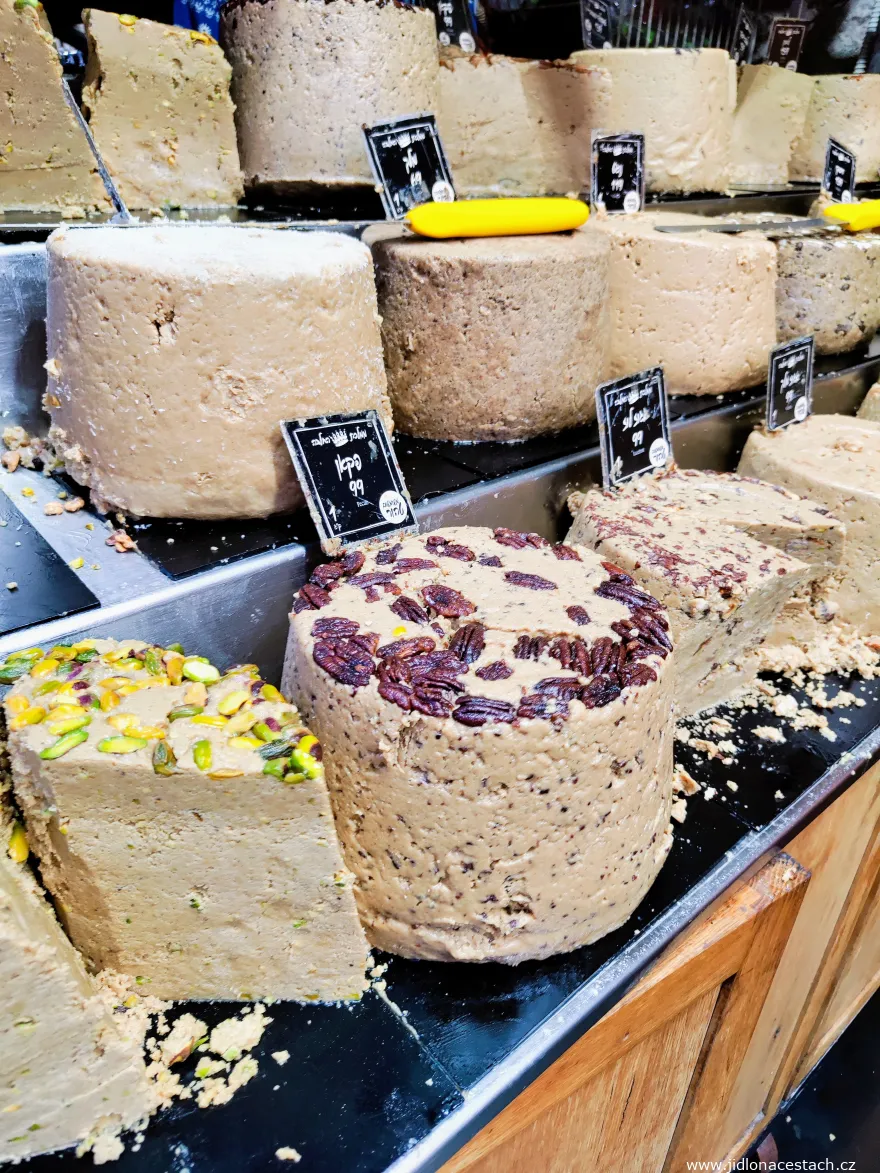
I ate halva in Jerusalem, at the Machaneh Yehudah market (see Where to Eat in Jerusalem), where several stalls were selling it in the evening: blocks lined up in rows, plain or coated in pistachios, with price signs in Hebrew above them. The vendor cuts off as much as you ask for, and freshly made halva differs from the boxed kind at the first bite - it's moister, the threads come apart easily, and the sesame has a slightly bitter note that the sugar doesn't drown out but merely rounds off. The pistachio one adds a salty nuttiness on top of that. The price was around 99 ILS (28 EUR) a kilogram, but as far as I could see, nobody there was buying a kilo; people buy pieces and taste flavors. I worked my way through several, one at each stall.


