Arab Markets by Damascus Gate: Shopping in Jerusalem Even on Shabbat
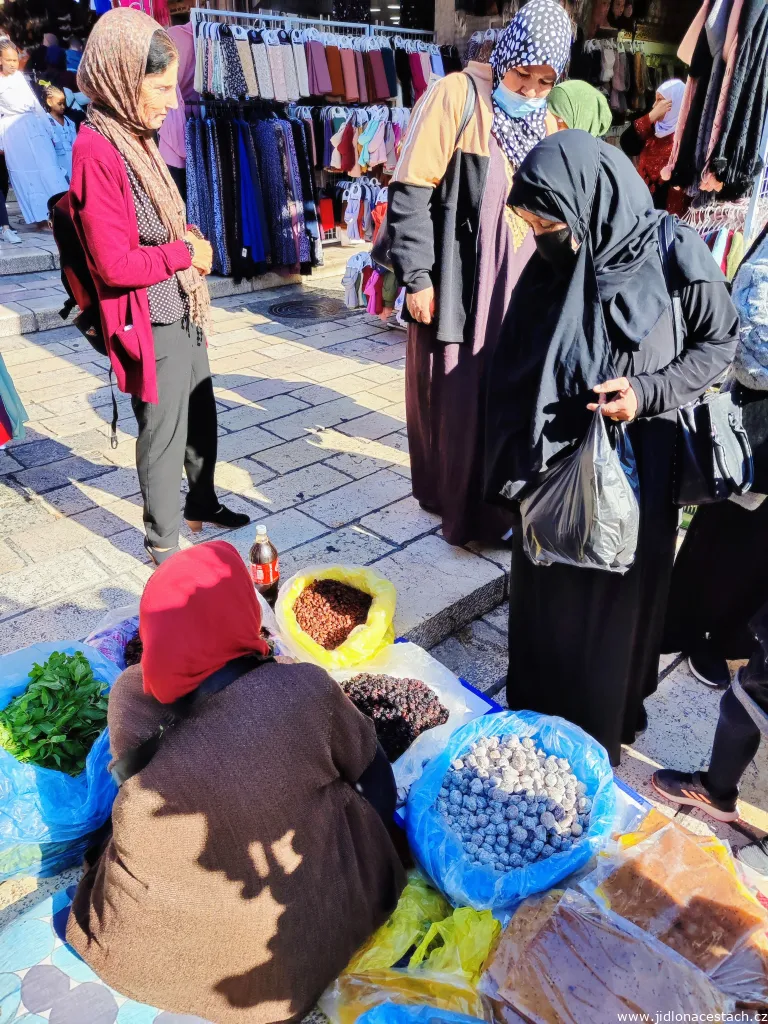
The scale comes first. A hand scale with a hook, the kind I'd only ever seen before in a school physics cabinet - here a vendor in a headscarf uses it to weigh sprigs of herbs right over the pavement she's sitting on, sacks and crates of goods spread out around her. Her whole shop fits on a strip of sidewalk.
The Arab markets by Damascus Gate are a maze of market lanes in the Muslim Quarter of the Old City of Jerusalem - and the surest place to get a meal in Israel even on Shabbat.

A Gate with Three Names
In English and Czech, the gate is named for the caravans that once set out from it toward Damascus. In Arabic it's Bab al-Amud (باب العامود), the Gate of the Column - named for a Roman-era marble column that once stood in the square just inside it; don't go looking for it today, it lies buried with the remains of the original gate below the level of the modern street. And in Hebrew it's Sha'ar Shechem, the Gate to Shechem, today's Nablus. Three languages, three names - and each one points somewhere different. The gate's current form was completed in 1538 by the builder Darwish al-Halabi during the great rebuilding of the walls under Suleiman the Magnificent. The market behind it is probably older: the main market street, Khan al-Zeit, takes its name from a medieval caravanserai where farmers used to bring their olive oil. Today it mostly sells shoes, hoodies, and spices. Only the name stayed with the oil.

A Market That Doesn't Keep Shabbat
On Saturday morning, Jerusalem's Old City is strangely quiet. I walked to the gate through side alleys and barely met a soul - which made it all the more startling when I turned a corner straight into a market in full swing. The Muslim Quarter runs on its own calendar: nobody here observes Shabbat, so while western Jewish Jerusalem shuts down almost everywhere from Friday evening to Saturday evening, by Damascus Gate people keep shopping, baking bread, and grinding coffee. It's more than happy to feed anyone who's timed their trip badly. The market doesn't run entirely without a break, though - on Fridays, around midday prayers, some vendors slip away toward al-Aqsa. So the Old City closes in three waves: Muslim shops on Fridays, Jewish ones on Saturdays, Christian ones on Sundays. Get those three days straight and you can always find something to buy in Jerusalem - Machaneh Yehudah Market in the west of the city and the souk by the gate take turns, like two shifts.

Vegetables from the Ground, Bagels from a Cart
The market's most striking figures don't sit behind counters - they sit right on the ground in front of them: countrywomen who bring in vegetables, herbs, olives, and oil each morning, spread them out on the pavement, and weigh them on hand scales. It's not a scene staged for tourists - local newspapers write about the women selling by Damascus Gate as fixtures of the place, and some of them have held the same spot for over thirty years. Around them spreads the usual souk assortment: sacks of spices, dried figs and nuts, sweets, headscarves, and sneakers. And bread - hatches between the shops hand out oval sesame kaak al-Quds bagels, hummus, and falafel. The market's main artery is also crossed by the Via Dolorosa, and the seventh station of the cross sits right among the stalls. Pilgrims and locals with shopping bags flow past each other in a single stream.

Cardamom and Czechoslovakia
We bought vegetables, olives, and fresh bread, then finished off at a cafe by the gate with a cup of cardamom coffee. It was thick, bitter, and topped with foam - I didn't need a heartier breakfast that day. A cup cost 10 ILS (2.80 EUR), and to go, in a paper cup, it's half that. The cafe owner asked where we were from - and he knew Czechoslovakia without missing a beat, thirty years after it stopped existing. I didn't correct him. Anyone heading onward can pick up a snack for the road at the gate: from the Arab bus station a few dozen meters further on, bus 231 runs to Bethlehem even on Shabbat, and a ticket costs 5.50 ILS (1.60 EUR). We sat a while longer over our coffee, watching the bustle. By Damascus Gate, time runs on its own terms: Shabbat never starts there, and Czechoslovakia never ended.


