Spa Wafers: A Crisp Sweet from Karlovy Vary and Other Spa Towns
Karlovy Vary is a wafer town and nobody disputes it, Brussels included - it made the claim official in 2011. But the wafer as you know it, two sheets with a sweet filling between them, is not a Karlovy Vary invention. The town has the oldest record of wafers being baked here; the shape the vendor hands you only took hold in the nineteenth century, in nearby Mariánské Lázně.
A spa wafer is two thin round sheets of crisp dough about nineteen centimeters across, stuck together with a filling of sugar and nuts, almonds, cinnamon or chocolate - a sweet souvenir that Czech cooking has travelled from the spa colonnades into every supermarket, and which in Karlovy Vary is baked with thermal spring water right in the dough.
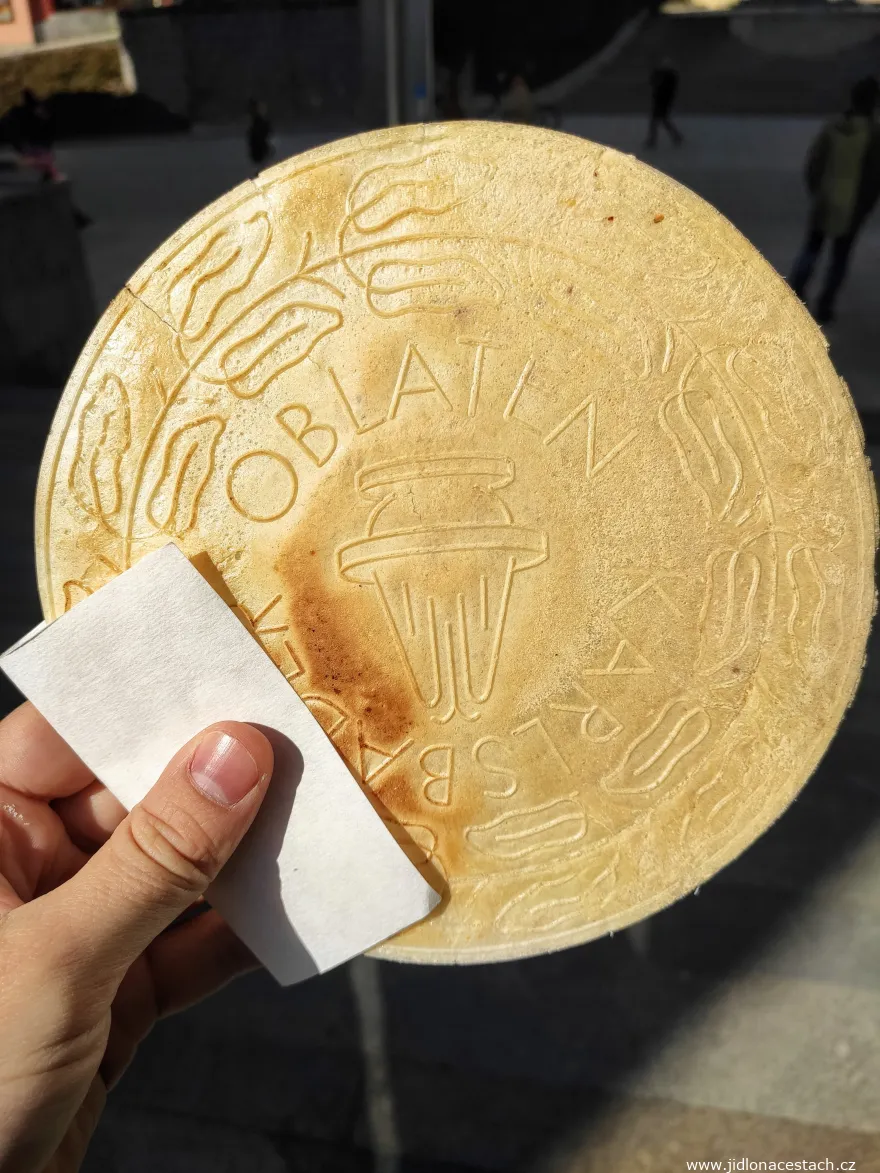
A Word Pressed into the Dough and a Fight over Who Owns It
The wafer in the photo above has the word Oblaten pressed into it. German, in a Czech spa town, but linguistically it is entirely above board: the Czech oplatka came through Old Bavarian from the Latin oblata, an offering, and the same root gives us the host the priest raises at Mass. The wafer and the communion host are siblings from the same irons - one stayed in church, the other got itself a filling. The pronunciation is no trouble. The trouble is who owns the name.
Czechia spent several years arguing with Germany and Austria over the name "Karlovarské oplatky"; European protection came through only in 2011, and only a wafer made with Karlovy Vary thermal spring water may carry it. The German side argued, among other things, that water from the Vřídlo geyser turns the wafer into a medicinal product, and a medicine, so the reasoning went, cannot be protected as a baked good. There are three layers to this: the Karlovy Vary wafer is local, the spa wafer is national - Mariánské Lázně has a protected one of its own, and they bake them in Luhačovice too - and the thin filled wafer itself is a legacy of the whole monarchy. In Hungary it is still called karlsbadi ostya, and the Austrian company O. Sacher, founded long ago in Karlovy Vary itself, renamed itself Original Wiener Oblaten after the dispute, because Viennese apparently sells better abroad. The name was fought over for years, and one of the few firms entitled to use it gave it up of its own accord.
The Year 1788 and What Karlovy Vary Did Not Invent
The oldest trace is a spa guide from 1788 which, among the comforts laid on for noble guests, mentions wafer making; the museum in Karlovy Vary holds a pair of wafer irons a year younger. Who baked the first one nobody knows - the guide describes something that was already up and running. The guidebook legend of Barbora Bayerová, who supposedly invented the wafers, falls apart twice over: she came to Karlovy Vary almost forty years later and did not open her wafer bakery until 1867. She did make them famous, and her company rose all the way to purveyor to the imperial court. After the Second World War, the expelled wafer bakers of Karlovy Vary took their fifteen-kilo irons with them to Dillingen in Bavaria, where Karlsbader Oblaten are baked to this day. And the wafer took the shape it has now, two sheets stuck together with filling, in 1856 in Mariánské Lázně - the birthplace of the Kolonáda brand, the model for spa wafers baked all over the country.
Thermal Spring Water in the Dough and a Warm Wafer on the Colonnade
The dough is pressed between two hot plates until it is almost translucent, and in Karlovy Vary it is mixed with water from the Vřídlo, for the dough and for the filling alike; the protected designation explicitly requires it. The filling is mostly sugar, with ground hazelnuts or almonds, cinnamon, vanilla or cocoa stirred into it; there is nothing else in a wafer, and that is exactly why nothing in it can be missing.
A box from the shop and a warm wafer from a stand are two different foods. The packaged one is a souvenir and survives the journey home; the one from the colonnade goes through a warmer just before it changes hands, the filling softens, the sheet turns crisp, and you eat it on the spot, broken into pieces or straight from the edge, because nineteen centimeters will not fit in your mouth any other way. If you want to understand why three countries went to court over a wafer, buy the warm one; you will never tell from a box.
A Warm Wafer Among the Springs
I ate the wafer in the photograph in Karlovy Vary. The filling was warmed through and sweet mostly from the sugar, with the nuts coming in behind it, and in one spot the wafer was baked darker than it should have been, which did it no harm at all. That taste came back to me unexpectedly a few thousand kilometers away, over an Iranian cake called koloocheh. Karlovy Vary did not invent the wafer. It just never let go of it.


