Putuk: Armenian Mutton and Chickpea Soup from a Clay Pot
I ordered a dish named after a pot and never got the pot. At Tavern Yerevan Khorenatsi in Yerevan, what landed on the table was an ordinary porcelain plate holding dark broth, a piece of mutton on the bone, a handful of chickpeas and a potato. The vessel that gave the soup its name stayed behind somewhere in the kitchen.
Putuk (Armenian պուտուկ) is a thick soup of mutton with chickpeas and potatoes that Armenian cuisine traditionally both cooks and serves in the small clay pot it is named after. A dish named after the pot it comes in is nothing unusual in the Caucasus; what is unusual is how many names this one soup can carry.

Putuk, Piti, and One Mixed-Up Pot
Cross the border into Azerbaijan and the same soup is called piti. Travel sites like to add that piti is the Turkic word for a clay pot - except it is the other way around. In Azerbaijani, piti is the name of the dish, and the pot it is cooked in is a piti dobu, a "piti pot". On the Armenian side it is supposed to work in reverse: according to Russian-language culinary encyclopedias, putuk is an old Armenian word for a small clay pot, and the soup borrowed it. So two neighboring cuisines cook from one recipe and each takes the name from the opposite end - one from what is inside, the other from what it is in. And to make things even less straightforward, Armenian recipe blogs these days tend to write piti themselves, while "putuk" is mostly what you find on restaurant menus - so you can run into both names and get the same thing every time.
Putuk is not an Armenian invention but a dish shared across the Caucasus and the Iranian world, one that Armenia and Azerbaijan argue over exactly the way they argue over tolma or baklava. Next door, the Azerbaijani town of Sheki is considered the piti capital, and there they eat it in two acts: first the broth is poured off into a bowl with dried mint, then what is left in the pot is mashed and eaten as a second course with bread. Iranian cuisine has the same idea in abgoosht. Turkish cuisine has meat with chickpeas as etli nohut, but cooked fast on the stove, with none of the ceremony of the pot.
What Goes Into the Clay Pot
The base is meat on the bone, ideally mutton with a piece of fat on it, and chickpeas, soaked overnight so they don't hold everything up. Both go in with onion and potatoes, covered with water; the pot is sealed and left in the oven for several hours so the ingredients can trade what they have: the fat from the meat softens the broth, the chickpeas drink it up, and the potatoes cook down so far that nobody can tell where the soup ends and the side dish begins. Saffron and dried sour alycha plums, which recipes online like to list as essentials, belong more to Azerbaijani piti or to holiday cooking - a home-cooked Armenian putuk does without them, and sometimes without the potatoes too, but with a handful of cilantro.
Putuk is a winter dish and a main course, not a starter - order it as the first of five courses and you'll never make it to the second. Bread goes with it, ideally the flatbread lavash or leavened matnakash to wipe the bottom of the dish, and the spoon does most of the work. Ask ahead whether they serve it in the pot. When it arrives in a putuk it is still bubbling and you finish it slowly; a porcelain plate is quicker, but it costs you half the show.
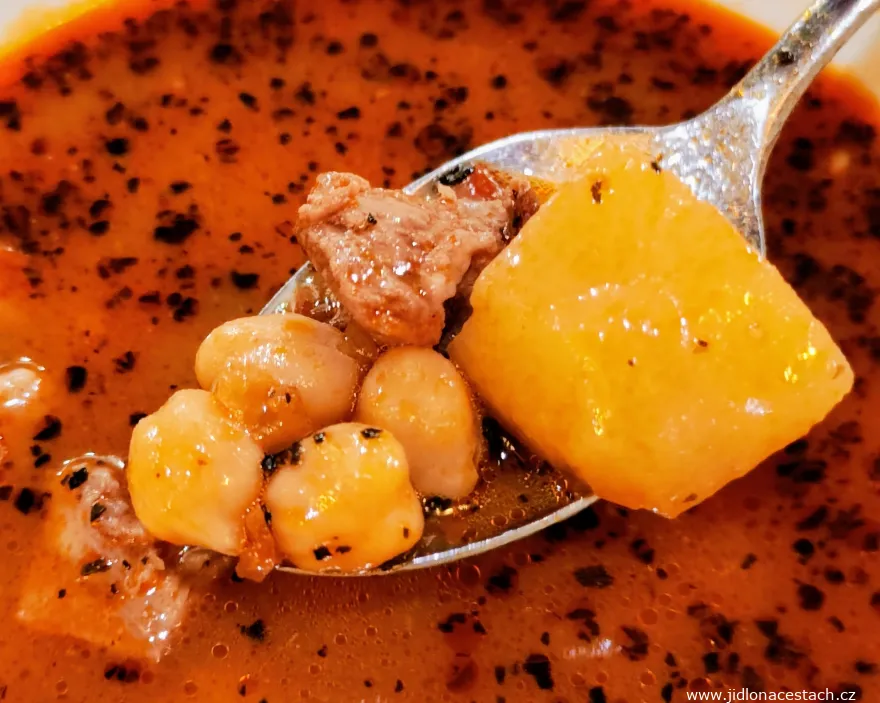
A Plate Instead of a Pot at Tavern Yerevan
I ate putuk in Yerevan, at the Khorenatsi branch of the Tavern Yerevan chain (see Where to Eat in Yerevan), where live folk music plays while you eat. The broth was dark, tinted orange by tomato and onion and dusted with black pepper, the meat on the bone gave way without a knife, the chickpeas stayed firm and the potato was falling apart as I spooned it up - in texture it sat somewhere between a soup and a stew, a rich meaty flavor with the pepper arriving only after you swallow. I never saw a clay putuk. The name stayed on the bill, though, and with it 1,700 AMD (4 EUR) for a portion that would have fed two.


