Cedevita: The Balkan Vitamin Drink Powder
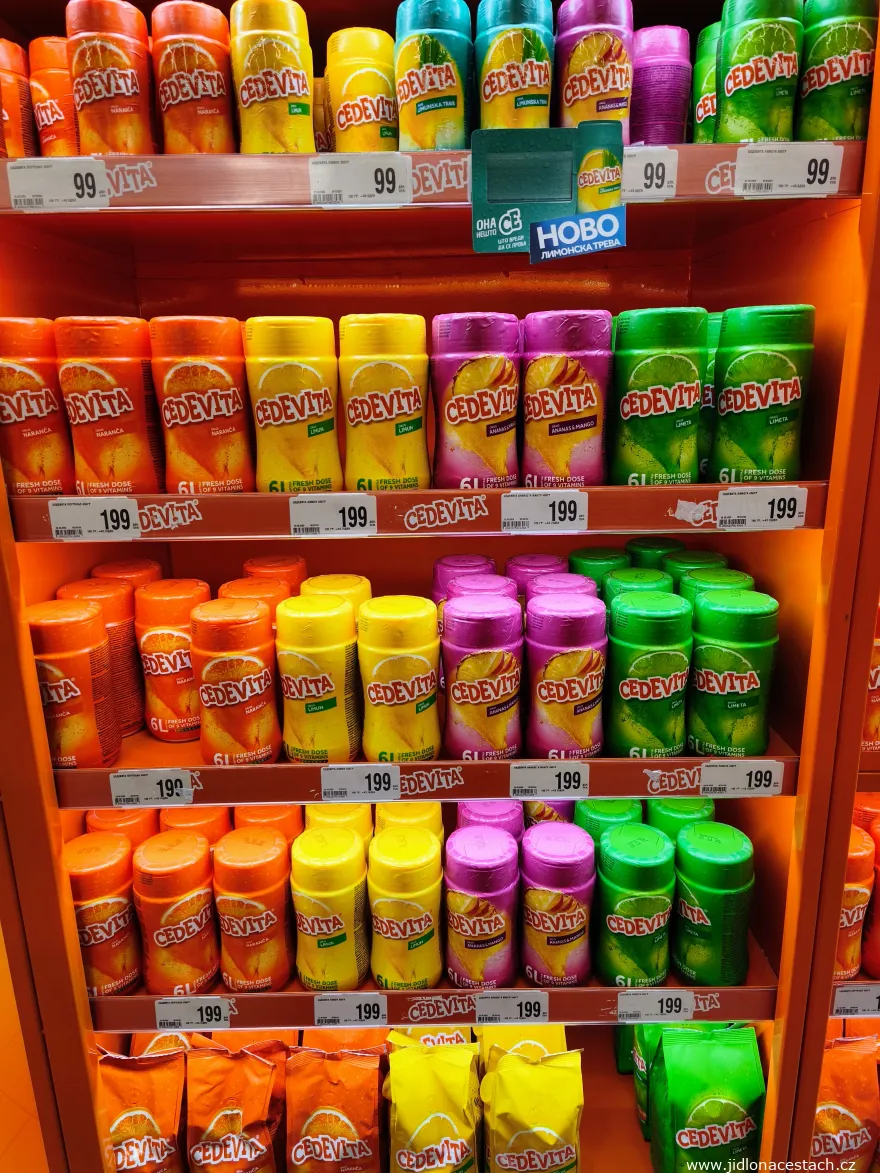
In the supermarket at the Skopje City Mall in Skopje I stopped in front of a shelving unit given over to a single brand from floor to ceiling. Four shelves of orange, yellow, pink and green tubs, sachets in the same colors underneath, and in the middle a blue NOVO sign announcing a lemongrass flavor. Back home you put beer or coffee on display like that, not powdered lemonade.
Cedevita (Macedonian: Цедевита) is an instant vitamin drink powder - sugar, citric acid, baking soda and nine vitamins, stirred into cold water; a Croatian brand the whole former Yugoslavia knows and one that sells in every shop in North Macedonia.
Where Cedevita Came From and Whose It Actually Is
The name sounds like a medicine, and that is no accident. Cedevita was born in 1969 at the Zagreb pharmaceutical company Pliva, the recipe was put together by pharmacist Martin Stanković, and the name is usually read as "C" (the vitamin) plus "vita" (life), although I couldn't track down any official explanation from the manufacturer. At first it was sold in pharmacies only, in little glass bottles with a measuring cap, and it didn't reach ordinary shops until 1983 - along with the first ads.
Within a single generation the vitamin supplement turned into a soft drink, and then it did what very few Yugoslav products managed: it outlived the country it was born in. Since 2001 it has belonged to Zagreb's Atlantic Grupa, and in Croatia, Bosnia and Herzegovina, Slovenia and Serbia it holds more than half the market in powdered vitamin drinks. In North Macedonia and Montenegro the same group brings it in through its own distribution companies; nobody passes it off as homegrown here either.
Cedevita isn't Macedonian - it is shared, like most of the things that outlived the old federation. The same family of drinks that pass for national but are really brands includes Iranian Zamzam, Swiss Rivella and Tunisian Boga; what sets Cedevita apart is that it doesn't arrive in a bottle - it arrives in a tub and you pour the water in yourself.
What's Inside the Tub
The tub is mostly sugar - glucose, to be precise - held together by citric acid and baking soda; those two meet in the water and the drink fizzes for a moment. The nine vitamins the packaging boasts about are the B complex, C and E. Anyone who went to school in the nineties will remember the same trick from those sachets of fizzy powder that got tipped straight onto the tongue instead of into water - and people in the Balkans share exactly that memory: in online discussions they recall licking Cedevita off their palm as kids and then explaining the orange mouth to their parents. The small sachets belong behind a café counter, where a nineteen-gram portion becomes a glass made to order; in Croatia "cedevita at the café" is a regular item on the drinks menu and the manufacturer keeps the habit alive with prize competitions.
Cedevita in Macedonia: The Rival, the Colors and When People Drink It
Macedonia does have an answer of its own. In Prilep, a company called Vitaminka has been making its own since the fifties, and it goes by Cevitana - also a powder, also nine vitamins, also orange and lemon, a name you can barely tell from the other one when you first hear it. Macedonian forums argue in earnest about which of the two is better, and the answer often comes down to whether you want "the homegrown one" or "the one from childhood". So anyone wondering why Cedevita is everywhere in Macedonia gets two answers at once: because the whole region has been drinking it for over half a century - and because it has a rival at home that keeps it fighting for a place on every shelf. And one more detail: in Macedonia a pharmacy chain carries Cedevita too, so after fifty years it has come full circle back to where it started.
People drink it cold, in summer, at breakfast, after exercise and, folk wisdom says, on the morning after an evening nobody talks about - take that last one as folklore, not as medical advice. The little glass pharmacy bottle is long gone, but the packaging is color-coded by flavor: orange for orange, yellow for lemon, pink for pineapple and mango, green for lime and, newly, turquoise for lemongrass. If you want to take a tub home with you, reach for the smaller one - it weighs next to nothing in a backpack and back home it turns into a few liters of summer.
The smaller pack cost 99 MKD (1.70 EUR), the big tub with "6 L" on the label - six liters of drink once you mix it - 199 MKD (3.30 EUR). I walked out with a photo and the feeling that I had just seen one of the few things everyone in the former Yugoslavia agrees on.
Have you ever tried Cedevita, at home or on your travels - and which color is yours?


