St. Martin's Goose: Why It's Roasted on November 11
When a farmstead in Radotice, Moravia, changed hands in 1552, the deed listed one more obligation alongside sixty groschen: year after year, the new farmer would owe the Telč estate "a white goose with red eyes." Not whenever he felt like it - on St. Martin's Day.
Old urbaria - the registers in which the lords of the manor wrote down what each village and each farmstead owed them - are full of entries like this, and they reveal more about the November 11 feast than all the legends put together: the goose didn't come to St. Martin from cookbooks but from account books. St. Martin's goose is roast goose with cabbage and dumplings that Czech cuisine puts on the table around November 11 - and so does half of Central Europe, because the day the farming year ended was marked in the calendar of a farmer near Znojmo just as it was for a burgher in Berlin.
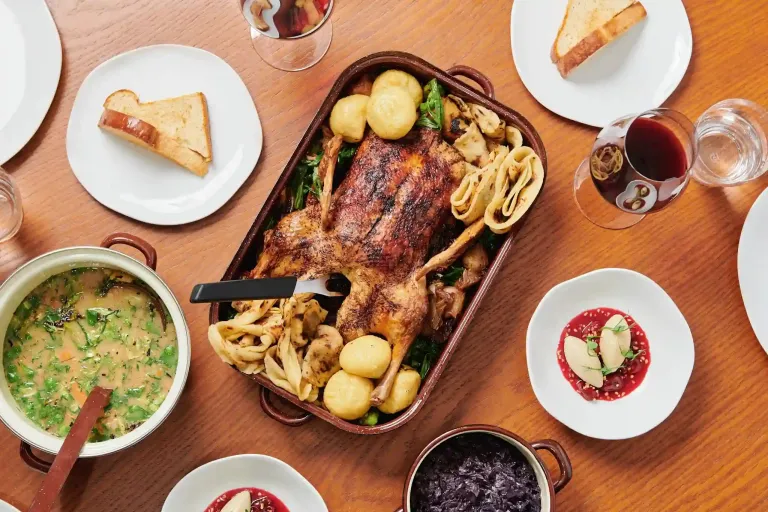
The Soldier Who Shared His Cloak
Martin was born around 316 in Savaria in Pannonia, today's Szombathely in Hungary. Before the Church made him one of the most revered saints in Europe, he served as a Roman soldier. The most famous scene of his life was recorded by his contemporary and biographer: in the freezing cold outside the gates of Amiens, in what is now northern France, Martin cut his military cloak in two with his sword and handed half of it to a beggar. That very half-cloak, in Latin cappa, was later kept as a relic by the Frankish kings - and it's from the place where it was kept that English still gets the words chapel and chaplain. The feast day doesn't mark Martin's death but his burial: he died on November 8, 397, and the calendars recorded November 11, the day he was laid to rest in Tours on the Loire. Over sixteen centuries his list of patronages has grown to include soldiers, horsemen, winegrowers and geese - and, according to Czech lists, teetotalers too, so he keeps a protective hand over both sides of the glass.
It's All the Geese's Fault, Supposedly
Why a goose, of all things? Legend has it that when Martin was about to be elected bishop of Tours, he felt unworthy of the office and hid - in a goose pen, of all places. The geese gave him away with their cackling, and they've been ending up in the roasting pan as punishment ever since. A second version is even harsher: a flock wandered into a church and disrupted Martin's sermon. Both stories have a catch, though. Neither appears in the work of Sulpicius Severus, the Aquitanian lawyer and friend of Martin who wrote the saint's biography while he was still alive, nor in in the medieval Legenda aurea, the Golden Legend, the most widely read medieval collection of saints' lives, compiled around 1260 by the Genoese Dominican Jacobus de Voragine - they first turn up only in the 16th century, more than a thousand years after Martin's death. Scholars call them secondary legends: they don't explain why people started eating goose, they only justify after the fact why it had long been eaten. The Czech legend found its own way, without punishing any birds: deep in the forest, a charcoal burner is said to have treated Duke Oldřich to goose with cabbage, and the delighted duke then supposedly ordered goose on St. Martin's Day for the whole land. Charming - but most likely only written down in the 19th century, and with nothing in the historical sources to back it up.
Geese in the Account Books
According to most scholars, the real trail leads to the farming calendar. All across Central Europe, St. Martin's Day used to be settling day: dues, rents and interest were paid, contracts were signed and farmhands changed masters - in the Czech lands, this lasted into the 19th century. Geese were paid in kind, exactly like that white one with red eyes from Radotice - and anyone who kept geese had them nicely fattened by November. The Church added a second reason: in the 5th century, Bishop Perpetuus of Tours introduced a fast from St. Martin's Day until Christmas, the Council of Mâcon in Burgundy confirmed it in 581, and over time this pre-Christmas fast developed into Advent.
So November 11 was the last day you were allowed to feast - and also the day when almost everyone had something to feast on.
Then there's the theory that poultry was slaughtered before winter anyway, so it wouldn't eat through the winter feed; it sounds reasonable, but it's only a guess. Documented evidence of feasting, on the other hand, is plentiful: an Old Czech carol promises that he "eateth the fat goose, drinketh the wine, and knoweth no sorrow," and the guild rules of Znojmo set out the dates between which geese could be slaughtered. A Würzburg chronicle from 1546 even pictured townspeople at a St. Martin's feast, goose and all. The very oldest "Martin's goose" in Europe, recorded under the year 1171 in a document written three centuries later, was made of silver, as it happens: a nobleman gave it to a monastery, and nobody ever ate a bite of it.
How the Rest of Europe Celebrates: Goose, Lanterns and Duck
Austrian cuisine roasts Martinigansl with red cabbage, dumplings and chestnuts, and in Burgenland, where Martin is the provincial patron saint, winemakers throw open their cellars for the new wine as well. Germany is split: the goose holds on mainly in Bavaria and in the countryside, while the Rhineland belongs to children's lantern processions. They look ancient, but they only took on their present form at the end of the 19th century - even a tradition can be younger than it looks. In Hungary, the goose feast and the new wine come with a saying that shows no mercy: whoever doesn't eat goose on St. Martin's Day will go hungry all year.
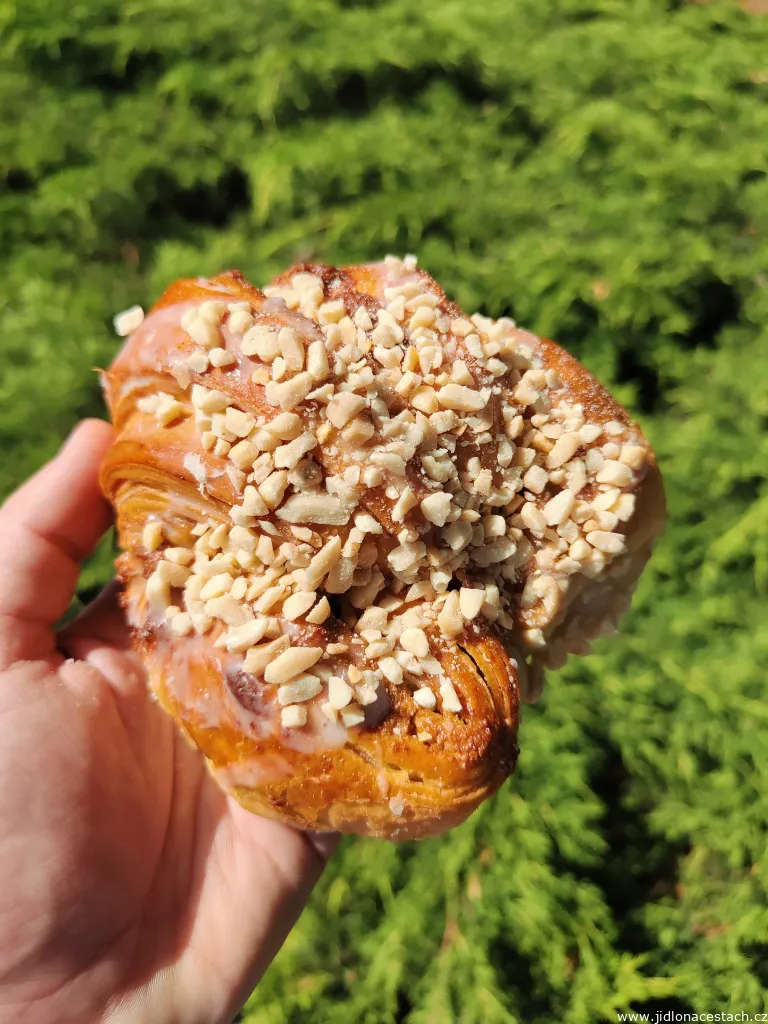
Poland is Europe's goose superpower, with a paradox of its own: it raises over seven million geese a year, but exports more than ninety percent of them to Germany, so plenty of the geese served as a Bavarian Martinsgans are Polish by birth; at home, a campaign called Gęsina na św. Marcina is trying to bring local consumption back to life. In Poznań, November 11 brings rogal świętomarciński alongside the goose - a croissant filled with white poppy seeds - and it all comes together with Polish Independence Day in one big street festival.
Denmark starts celebrating on the evening of November 10 and has almost entirely swapped the goose for cheaper duck, while in Skåne, in southern Sweden, they serve goose blood soup before the goose. But the biggest curiosity is saved for France: in the country where Martin served as bishop and where his tomb lies, nobody eats St. Martin's goose outside Alsace. Italy, meanwhile, associates November 11 mainly with chestnuts and new wine, and roasts goose only in the north.
A Wing for the Stable Boy, the Breast for the Farmer
In the Czech lands, the feast used to mark, above all, the end of the farming year. On St. Martin's Day wages were paid and it was decided who would stay on in service; a farmhand whose service the farmer didn't renew got St. Martin's rolls and horseshoes filled with poppy seeds or plum butter from the farmer's wife as a parting gift. Even the carving had its rules: the wing for the youngest stable boy, a leg for the older farmhand, the breast for the farmer - you could read everyone's place at the table from their plate. The goose's breastbone was then used to forecast the weather: white meant a hard winter, dark meant lots of snow - except the sources contradict each other on the colors so reliably that this prophecy can never be proved wrong. Even the most famous weather saying isn't much more reliable. An old Czech proverb has St. Martin arriving on a white horse - that is, bringing the first snow - yet according to data from the Czech Hydrometeorological Institute, he rides into the lowlands on his white horse only about one year in eight, roughly as often as we get a white Christmas.
The Comeback After 1989
The 20th century nearly silenced the tradition: the interwar republic struck a number of church holidays off the calendar, the word "St. Martin's" disappeared from posters, and the communist regime that took power in 1948 finished the feasting off for good. The revival after 1989 had an unexpected engine - Moravian winemakers who, following the example of Beaujolais nouveau, launched the young Svatomartinské wine (St. Martin's wine), opened around November 11; it overtook its French model in Czech sales as early as 2006, and the goose rode back onto the tables on the wine's coattails - the sideshow that ended up outgrowing the main act. Today almost the whole country roasts or books a goose around November 11: some 160,000 Czech geese are fattened every year, enough for about a million portions, and imports from Poland and Hungary make up the rest. So Bavaria is far from the only place where Polish geese end up. Restaurants put out St. Martin's menus for the first half of November, and people start asking about the most sought-after tables as early as September; you'll find my tips for well-known places in the article Where to Go for St. Martin's Goose in Prague.
Goose at Our House
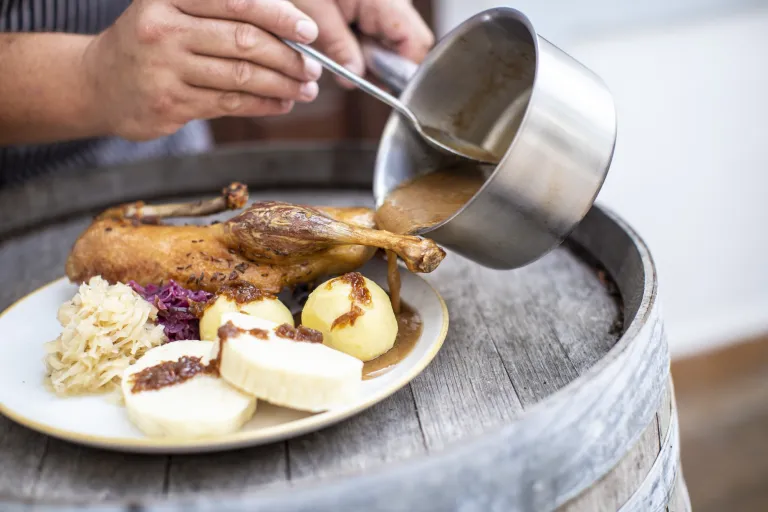
At our house, we roast a goose every year, and quite often I'm the one in charge of it. I roast it very slowly, until the meat practically falls apart and comes away from the bone on its own - and I make homemade Carlsbad dumplings and red cabbage to go with it. And because goose isn't a dish for one, I always invite someone over. Nobody pays dues to the lord of the manor anymore; only that November goose still gets handed over at our house - voluntarily, and to the guests.


