Kroasan so Kaškaval: Croissant with Cheese from Balkan Bakeries
Of all the dishes in this section, kroasan so kaškaval has the shortest Macedonian pedigree: none at all. The croissant came from Vienna by way of Paris, its savory cheese version from twentieth-century French bakeries, and it was bakeries, not history, that brought the whole thing to the Balkans. Yet today it sits on the shelf next to burek, and at Silbo bakery in Skopje they pile on the cheese so generously that you have to go looking for the croissant underneath.
Kroasan so kaškaval (Macedonian: кроасан со кашкавал) is a croissant made from leavened puff pastry with yellow kaškaval cheese - filled inside or piled with grated cheese on top - a breakfast from the counter of a modern bakery, sitting right next to traditional burek.

Two Loanwords on One Pastry
The name is a double import. Kroasan is the French croissant, a crescent moon, which Macedonian borrowed shape and all. The more interesting half is the second one: kaškaval, the yellow Balkan cheese, is named after the Italian caciocavallo, literally "horse cheese," and Bulgarians, Serbs and Turks all know the same word - among the Turks, the traveler Evliya Çelebi had already written it down before 1680. Italian linguists themselves admit it could have been the other way round: that caciocavallo took its name from the Balkan kaškaval, not the reverse. Either way, no horse is actually involved.
The geography is just as honest as the name: a croissant with cheese is not a Macedonian or Balkan invention, it's a shared pastry of modern bakeries across the Balkans. A Bulgarian bakery sells kroasan s kaškaval, a Serbian one kroasan sa kačkavaljem, and Greek bakeries top their kruasán with gouda rather than homemade kaseri. The real relatives are elsewhere: byrek and Macedonian burek layer their cheese between sheets of stretched dough and are eaten at the same breakfast, while šarska pleskavica uses the very same kaškaval, just tucked inside the meat. In this family, the croissant is the one who came from abroad and adapted.
Burek Lost the Race to Croissants
This pastry's history is short enough to fit in a newspaper headline. The Belgrade daily Politika ran exactly that: "Burek izgubio trku sa kroasanima" - burek lost the race to croissants - people, it seems, started having croissants for breakfast instead of đevrek, and bakeries that once only knew how to make burek added Western pastries to the counter as well. The savory cheese croissant itself was invented in France in the twentieth century as a way to use up yesterday's unsold croissants: fill them, bake them again, sell them again. No source says exactly when it reached the Balkans.
The Cheese That Melts, on Pastry That Flakes
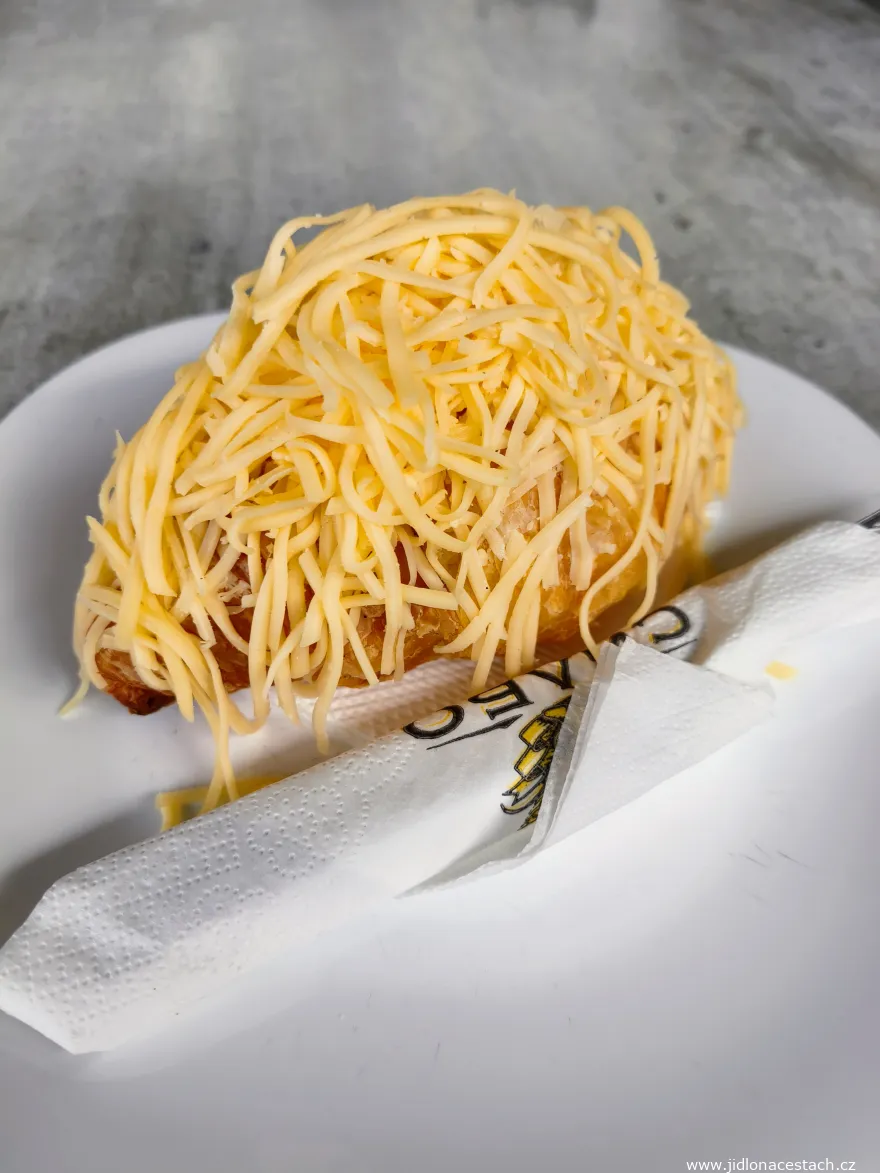
Kaškaval is the main character in this pastry, and the croissant is just the stage. It's a yellow, stretchy cheese made from cow's or sheep's milk that, unlike the crumbly white sirenje, goes stringy and melts when warm - which is why it goes into burek, onto pleskavica and onto croissants alike. At Silbo, though, they didn't hide the cheese inside - they piled it grated on top, in such a thick layer that the pastry underneath looked like nothing more than a base for it. The result resembles a homemade toastie from a sandwich press where someone grated on more cheese than bread - except instead of bread, underneath there's puff pastry.
It's eaten in the morning, standing at the bakery counter, and rarely alone: the Macedonian bakery breakfast is burek with a cup of sour milk, and the cheese croissant is the newer addition to that same counter. Silbo is open twenty-four hours a day, so it works even after a very long night. If you want to try it, treat the croissant as a second course to the burek, not the main event - the reason to walk into a Skopje bakery is still burek. And alongside it, yogurt or sour milk: it's two servings of cheese on one tray, and something sour between them doesn't hurt.
A Two-Course Breakfast at Silbo
I tasted kroasan so kaškaval in Skopje at Silbo bakery (see Where to Eat in Skopje), a well-known bakery where I added a croissant to my burek out of curiosity. It was pretty unconventional. The portion of cheese was extreme: a heap of grated kaškaval covered the croissant entirely. The croissant cost 55 MKD (0.90 EUR), and there really was more cheese on it than I could count.


