Doce Uvas de la Suerte: Twelve Grapes for a Spanish New Year's Eve
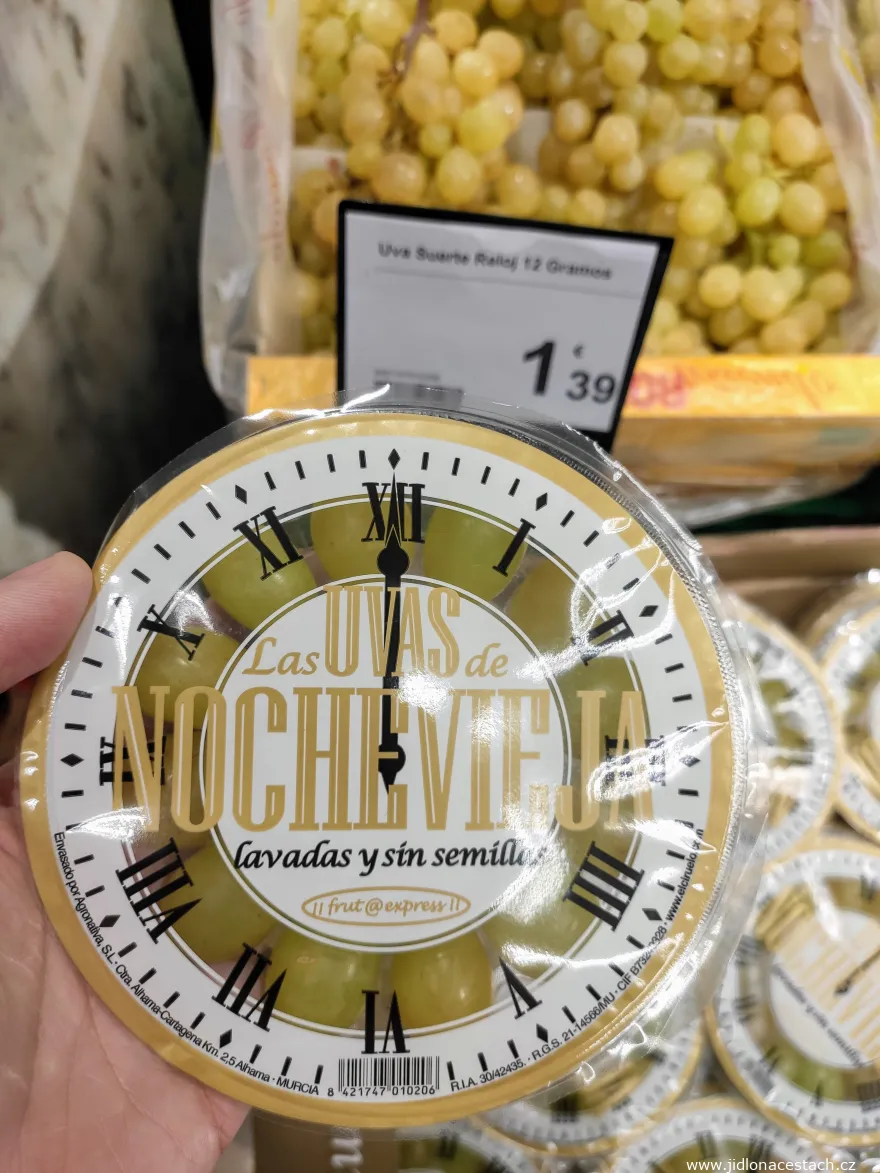
Two days before New Year's Eve, something on a supermarket shelf in Malaga looked like a clock. A plastic box with a dial, Roman numerals around the rim, and in each of the twelve compartments a single grape, washed and seedless, just as the label promised. For a few days every December, the whole of Spain buys its time by the piece.
Doce uvas de la suerte, the twelve grapes of luck, is a Spanish New Year's custom: with each of the twelve strokes of the midnight bell you eat one grape, one grape for one month of the coming year. Anyone who gets through all twelve is said to have the year sorted. Anyone who doesn't at least ends up with a mouth full of grapes, which isn't a bad way to start either.
What Doce Uvas Really Means and Where Else Midnight Counts to Twelve
The Spanish uva is a trap for anyone who doesn't speak the language: it isn't a whole bunch, it's one single grape. Twelve bunches, the way Czech websites translate the custom, would keep a family going for a week; twelve uvas fit in the palm of your hand. The custom is nationwide and its symbolic center is Puerta del Sol in Madrid, where television carries the chimes into every household in the country, year after year. The one exception is the Canary Islands, which have their own time zone and eat their grapes an hour later than the mainland; one year the broadcasters solved it by showing midnight twice. Spanish emigrants took the custom to Mexico and on into Latin America. Neighboring Portugal has the same ritual with twelve raisins, because fresh grapes were nowhere to be had there in December.
A Bourgeois Fad, Mockery from the Street, and the Legend of a Bumper Harvest
The version you hear most often involves the winegrowers: one year in Alicante, the story goes, they picked so many grapes that they had nowhere to put them, so they sold the surplus as "grapes of luck" for New Year's Eve. These days even the head of the Alicante wine board dismisses that version: in the Spain of the day, a surplus of anything was rare, and fresh grapes in December a technical miracle. The documented trail is older and far more down to earth: as early as January 1894, a Madrid newspaper described the custom of eating grapes on the strokes of midnight as something "imported from France" that had "already caught on" in Madrid. Wealthy Madrileños were copying the French and German aristocracy, who saw the New Year in with champagne and grapes. Ordinary people on the street turned the fad into a joke: they took to eating their grapes right there in Puerta del Sol, under the clock of the Casa de Correos, which has been striking there since 1866. What began as a parody of snobs is now the minute that every Spanish television channel broadcasts at midnight. Around 1909 the growers in Alicante could at most have helped the custom spread with their packs of twelve; they were far too late to have started it.
How the Twelve Grapes Are Eaten
The bell runs the evening, not the grape. Midnight at Puerta del Sol doesn't begin with the first strike: first the ball drops down the tower, then a carillon of bells plays, and then come four double chimes marking the quarters. Only after that do the twelve main strokes arrive, about three seconds apart, and that is the only window in which the grapes may be eaten. Start on the quarters and you finish before the year has even begun, and the Spanish will calmly put you right. Three seconds per grape, skin and seeds and all, is the pace you remember from the school canteen just before the bell, and that is exactly why a whole trade in packaged grapes sprang up: packs of twelve washed, seedless grapes, in little tubs or canned in syrup, have been on sale since the turn of the millennium in supermarkets and from growers in the Vinalopó valley near Alicante, where the white aledo variety is picked so late that it stays fresh until New Year's Eve.
The grapes are eaten mostly at home, with the family around a table where the cava is already waiting for a toast the moment the twelfth stroke fades; anyone who wants a crowd heads for the square. Younger Spaniards have added a superstition of their own: grapes eaten under the table bring love in the new year. If you want New Year's Eve the Spanish way, put your phone down before midnight: the twelve strokes take half a minute, and there is no filming your way through them.
A Rooftop Above Malaga
I ate my twelve grapes in Malaga, in a rented apartment in the center of town that came with a roof terrace. And ours wasn't the only one: the roofs all around were full of people celebrating together, voices carrying across the street from terrace to terrace. Before midnight that changed. Most of them were simply waiting for the chimes, impatient, getting their little plates of grapes ready. They were ordinary table grapes, nothing more; flavor isn't the point here. In the last seconds of the old year the terraces fell quiet, everyone eating, making their wishes, taking a moment to look back at the year that was ending. Twelve strokes, twelve grapes, the whole city silent. The box with the clock face was empty before the bell from Madrid had finished ringing on the television.


