Tête de Moine: The Swiss Cheese You Shave into Rosettes
Almost every cheese in the world gets sliced. Tête de Moine doesn't, because a knife would turn it into just another hard cheese with a sharp bite. Go at it with a blade and you miss the whole point: only a thin ruffled shaving, one that melts on your tongue before you can chew it, gives the flavor room to open up.
Tête de Moine is a semi-hard Swiss cheese made from raw cow's milk in the Jura mountains, and instead of being sliced it's shaved into thin rosettes with a little machine - and that's the form people know well beyond Switzerland: pungent, and going by the name "monk's head".

What Tête de Moine Means and Where It Gets Shaved
In French it literally means monk's head, and the explanation guidebooks like best is that the rosettes are shaved off the top of the round the way a tonsure was shaved off the crown of a monk's head. Except that for almost six centuries the cheese was known simply as Fromage de Bellelay, after the abbey where it was born, and "Tête de Moine" first appears in writing in 1790, in an official price list from the years when revolutionary France occupied the region. One version has French soldiers coining it as a jibe; another says the cheese was counted out in the monastery courtyard "by monks' heads", as an annual allowance. The only certainty is that the name is younger than the monks it supposedly describes - and that the cheese has kept it ever since.
Only eight dairies in four districts of the canton of Jura and the Bernese Jura, up in the mountains of French-speaking Switzerland, are allowed to make it; since the turn of the millennium the AOP protected designation has guaranteed that, and ten years later the European Union added its own protection. It's a regional cheese with a nationwide reputation, and more than half of what's made leaves the country. Keep an eye on the map, though: the Jura range carries on into France, where they make Comté and Morbier - a completely different cheese family, no relation. Among Swiss cheeses its closest neighbor is Appenzeller (similarly pungent, but cut into slices), and the same range also gives us Vacherin Mont-d'Or, a soft winter cheese in a spruce band that you eat with a spoon. Tête de Moine is the only one of them that got a tool of its own.
Who Came Up with Tête de Moine and Who Shaves It
It starts at Bellelay Abbey, a Premonstratensian monastery founded in the 12th century in the hills of the Bernese Jura. The oldest record dates from 1192, and it says nothing about a recipe - it's about a payment: cheese from Bellelay was handed over as part of a feudal due. The picture of monks bent over the vat is a legend; the monks only supervised, and it was the tenant farmers around them who actually did the cheesemaking. When the French Revolution drove them out of the monastery, the cheese stayed on the farms; in the 19th century a farmer named Hofstetter made a name for it at the world's fair in Paris, and the rounds travelled as far as Russia. All that time the cheese was scraped with a knife. The girolle, which today belongs with it as much as the plate does, was built in 1982 by Nicolas Crevoisier, a mechanic from the Jura village of Lajoux; his daughter named it after the chanterelle, because the shavings reminded her of its cap, and over three million have been sold since. So the tool that looks like an age-old tradition is roughly my own age.
What Tête de Moine Tastes Like and How to Eat It
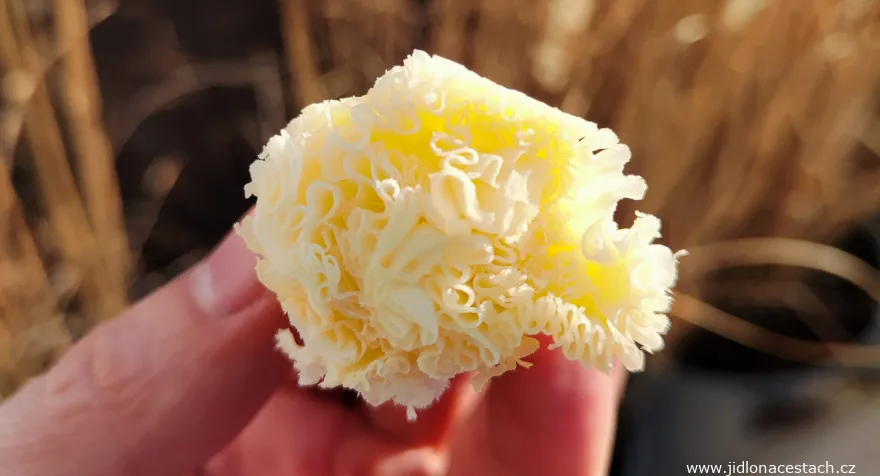
There are three ingredients: raw cow's milk from mountain pastures, a copper vat and time. A round weighing seven to nine hundred grams ripens for at least 75 days on spruce boards in a damp cellar, and all that time the rind is washed with brine, which turns it brown and gives the cheese its punch; the Réserve ripens for over four months, and you can taste it. The real difference, though, comes from the girolle: the cheese is fixed onto a spindle, the blade turns around it and lifts a wafer-thin layer off the surface, which curls into a rosette all by itself, the way you scrape chocolate curls off a bar for a cake at home. It's a pencil sharpener turned inside out - the blade spins and the pencil stands still. A shaving has a lot of surface area, so it dissolves on the tongue at once, and the same cheese that would come across as merely salty and sharp in a slice suddenly finishes on a nutty note.
Rosettes belong on the aperitif table and on the cheese board, where they're the first thing to go, because you eat them with your fingers. In the second half of the 19th century the cheese was made only twice a year, at Christmas and Easter, and in Germany and elsewhere it's still a popular Christmas present. If you're bringing some home, reach for half a round and a girolle in the shop rather than a tub of ready-made rosettes - per hundred grams the round works out considerably cheaper, and the shaving is half the fun.
A Tub of Rosettes from a Swiss Supermarket
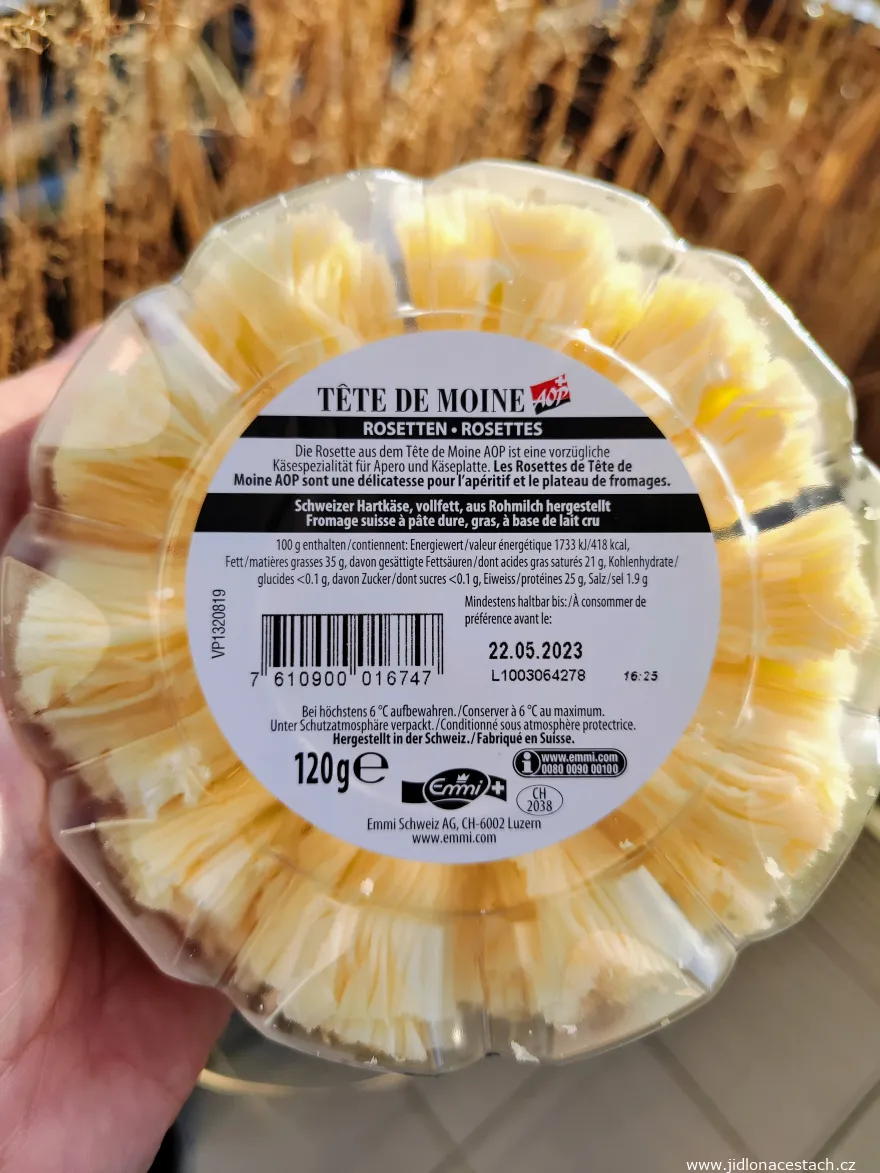
I'll admit right away that I've never held a girolle. I bought my Tête de Moine ready to eat in a Swiss supermarket: a tub of 120 grams of rosettes from Emmi, the AOP stamp on the bottom, for 5.95 CHF (5.95 EUR). I opened it outdoors in the sun, and held up to the light, the shavings were thinner than paper. Salt and a sharp pungent kick come first - then the rosette melts away and leaves a nutty, almost sweet finish that lasts longer than the cheese itself. The tub was empty before I'd worked out what to use it for.


