Hejnická putovnice: A Monastery Lager for the Pilgrimage Town of Hejnice
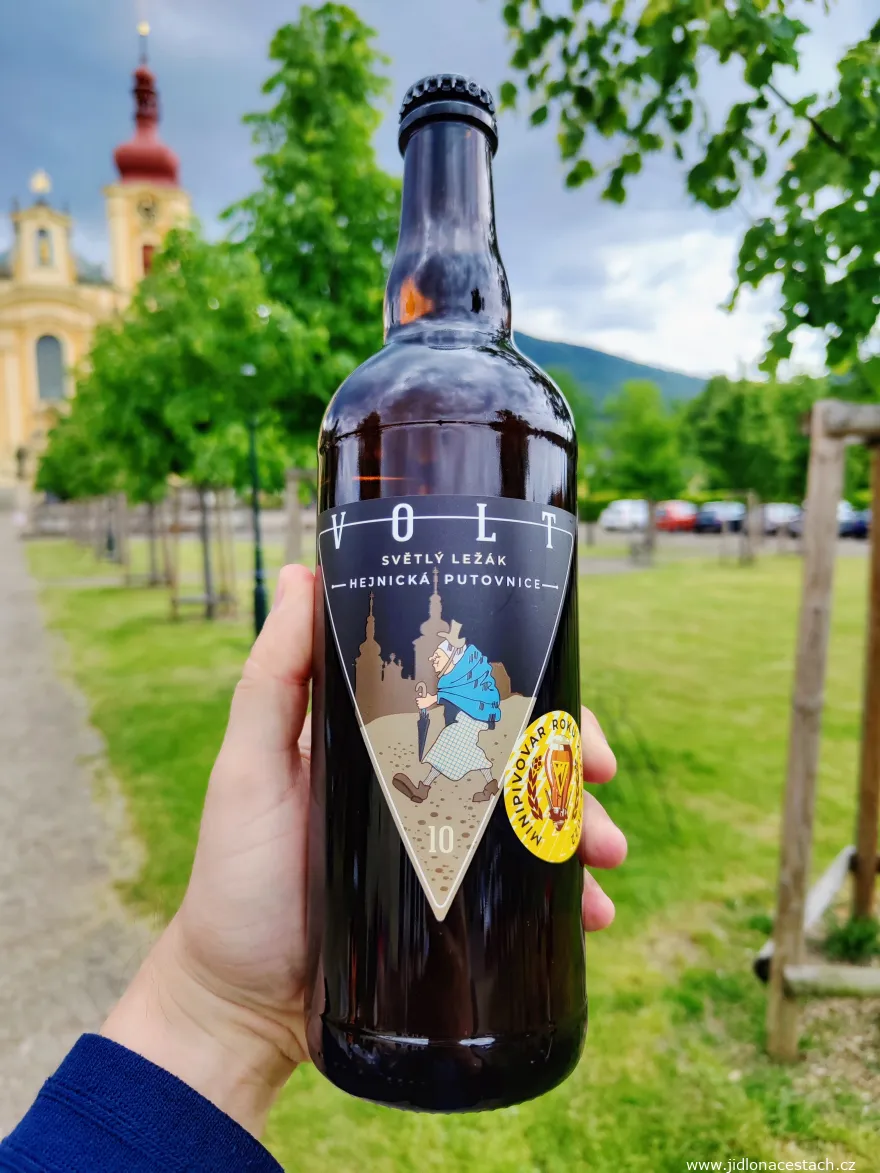
The label tells you more than the word "monastery" printed above it. It is black, triangular, and in the middle strides a woman in a blue cloak with an umbrella, her head down and her stride clearly not expecting company. Behind her, the silhouette of church towers. Below her the number ten, above her the name Volt, and on the neck a yellow Microbrewery of the Year sticker. If you can read a label, you already know everything that matters: where the walk is headed, who actually brewed the beer, and how much it thinks of itself.
Hejnická putovnice is a pale, unfiltered and unpasteurized lager, a ten-degree beer by the Czech scale of original gravity, which the monastery in Hejnice in the Frýdlant region has brewed for it at the Volt microbrewery in Jablonec nad Nisou and sells to pilgrims and spa guests in 0.75-liter bottles - the kind of monastery beer Czechia does best, which is to say without a single monk.
Who the Putovnice Is and Where She Is Off To
You will not find the word putovnice in any dictionary; the monastery made it up. It is supposed to mean a sprightly old lady stepping out briskly toward the pilgrimage church in Hejnice - exactly the one on the label. She is heading for the Basilica of the Visitation of the Virgin Mary: legend has it that a poor sieve maker fell asleep here under three linden trees by the river Smědá and was told in a dream to hang a statuette of the Virgin on one of them; his wife and child were healed, and people started coming. The legend is vague about the year and the written record only starts in the fourteenth century, but the pilgrimage site that grew out of it was reportedly drawing up to 120,000 people a year under the Gallas family. The Franciscans, who ran the monastery beside the basilica from the end of the seventeenth century, looked after them. And a pilgrim who has walked all the way is just as thirsty after mass in any century.
Monastery Beer Without Monks
The catch is that no Franciscan has lived in Hejnice for a very long time. In April 1950 the communist regime turned the monastery into an internment camp: in the course of a single day it moved a hundred and fifty men from disbanded orders into cells built for about twenty. Monastic life never came back; since the turn of the millennium the restored building has been run by the diocese as an education, conference and pilgrimage house. So the monk with a mash paddle that the word "monastery" promises was never here at all. But that is perfectly normal in Czechia. The only monastery in the country that brews beer under its own company is Želiv, run by the Premonstratensians; the famous monastery breweries in Prague are tenants inside monastery walls, and the only Czech Trappists, the monks of Nový Dvůr, do not brew beer at all - they make mustard. I could not track down the exact year the putovnice was first brewed.
In Belgium, whose monastery beers I have a soft spot for, the question is taken seriously: a Trappist beer may carry its mark only if it is brewed inside the abbey walls under the supervision of the monks and the proceeds go to running the monastery and to charity - and when the last monks left one Belgian abbey, the beer lost the mark along with them. The putovnice is brewed by Volt, a small secular brewery in a villa in Jablonec nad Nisou. Then again, this is the Volt that was voted Microbrewery of the Year in 2021 and 2022 in the poll run by the Sdružení přátel piva, the Czech beer lovers' association; yes, that is the yellow sticker on the label. A monastery without monks picked a brewery with titles. A sensible division of labor: one side supplies the name and the pilgrims, the other knows how to brew.
A Ten-Degree Lager by Martin Palouš
The recipe was written by Volt's head brewer Martin Palouš and it looks modest: a pale bottom-fermented lager of ten degrees, hopped with Magnum and žatecký poloraný červeňák, the classic Saaz red-bine variety; it comes in at around four percent alcohol. Unfiltered and unpasteurized means the yeast stayed in the bottle and nobody heated the beer a second time to give it shelf life - which is why it is cloudy, why it tastes fuller than a ten-degree beer has any right to, and why it wants to be kept cold and does not want to wait. It is the difference between bakery bread and packaged sliced bread: the first tastes better, the second keeps. The bottle is unusual by Czech standards, three quarters of a liter and closer in shape to wine than to beer - you take it to someone's house instead of a bottle of wine, and the host opens it right away anyway.
You drink it where it is sold: in the monastery restaurant and at the U kostela pastry shop right beside the basilica, somewhere between the coffee and the spa wafers. Alongside the pilgrims, the customers here are guests from the spa town of Lázně Libverda next door, where joints and hearts are treated with carbonated mineral water - mostly older people with firm standards for both coffee and service, and running a pastry shop for them does not strike me as an easy way to make a living. Buy your bottle on the way back from the basilica, not on the way there: an unfiltered ten-degree and two hours in a backpack in the sun may not get along.
A Bottle in Front of the Basilica
I bought my putovnice at that same U kostela pastry shop in Hejnice and photographed it in front of the basilica before I took it home. It was a good ten-degree: golden, with a yeasty fullness and a bready sweetness, and the bitterness of the Saaz hops only came in on the finish and was in no hurry to leave. For a ten-degree, the beer had terrific flavor and a proper bite. The 0.75-liter bottle cost 130 CZK (5.20 EUR). In Belgium the Trappists would never have put their stamp on this beer, not without a monk and not without an abbey wall. In Hejnice it got away with it - and with me, too.


