Caponata: Sicilian Sweet-and-Sour Vegetables with Eggplant
Everyone in Sicily tells you the same story about caponata: the barons ate an expensive fish called capone in a sweet-and-sour sauce, the poor couldn't afford it, they swapped in eggplant, and the name stuck. It's a good story, and linguists of course don't buy it.
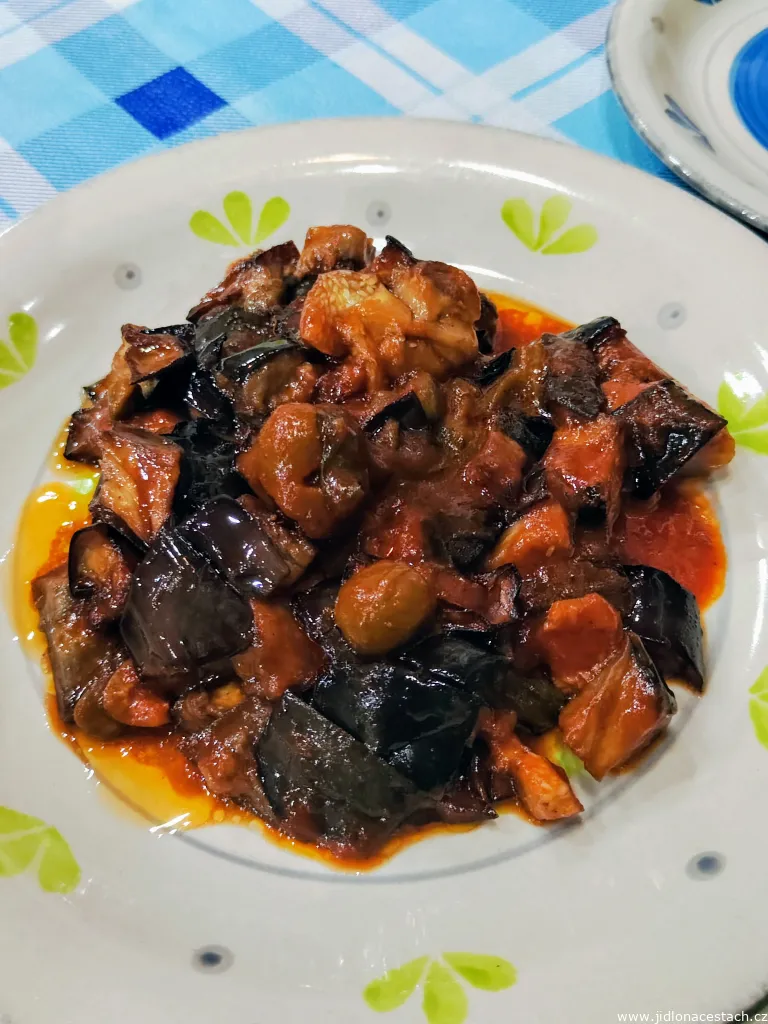
Caponata is a Sicilian sweet-and-sour mix of fried eggplant cubes, celery, onion, green olives and capers in a tomato sauce with vinegar and sugar, served cold as an appetizer or a side - a dish that Italian cuisine knows all over the country, but that only one island claims as its own.
What Caponata Means and Where It Gets Cooked in Sicily
The linguists' version is less touching. The Treccani dictionary traces caponata back to the Latin capponem, capon - by way of cappone di galera, galley capon, a mocking nickname for a dish with no meat in it whatsoever. So the fish makes the better story and the capon the better etymology, and you can take whichever you happen to need: an anecdote to go with dinner, or the truth.
Caponata belongs to all of Sicily; the island's official list of traditional products has it down as caponata di melanzane, and every region has tweaked it: Palermo keeps the plainest version, Catania adds peppers and pine nuts, Trapani toasted almonds. Its closest relative lives on Malta and goes by the name kapunata - same technique, same vinegar, just without the nuts and raisins; both islands spent centuries under the same Aragonese crown. Provençal ratatouille from French cuisine sits further away than the menus would have you believe: there the vegetables stew together and nobody pours vinegar over them. French websites still explain caponata to their readers as "Sicilian ratatouille" - the original introduced by way of its copy. And watch out for Naples: caponata there is a bread salad with sardines, and you won't find any eggplant in it.
A Dictionary Before a Cookbook
The earliest record of caponata isn't a recipe but a dictionary entry. In the Latin-Sicilian dictionary Etymologicum Siculum, printed in Messina in 1759, caponata is defined as "a dish of various chopped things" - a definition so cautious it would still hold up today. Cookbooks took another sixty years to notice; the first to write it down was the Neapolitan Il Cuoco galante in 1820, and in 1869 the Pensabene family in Palermo started canning it and shipping it across the ocean to emigrants who missed the taste of home. Everything before that dictionary comes down to us by word of mouth alone: breakfast for galley oarsmen, hardtack soaked in vinegar and oil with onion and dried fish, where the vinegar mainly kept the food from spoiling at sea. That dish shares a name and a sourness with today's eggplant version, but nobody has ever proved a direct family line. What the internet will reliably tell you, on the other hand, is that "there are over thirty recipes".
Why the Eggplant Is Fried on Its Own and Why Caponata Waits Until Tomorrow
The key to caponata is the division of labor. The eggplant is cut into cubes and fried on its own, and it only goes into the sauce once it's done; the celery and onion are stewed separately, and only then does everything meet in the pan with vinegar and sugar - throw the vegetables into one pot and you'll make something good, but not caponata. As it fries, the eggplant soaks up oil like a sponge, and it's that oil that then carries the flavor of the whole bowl; the celery keeps the crunch, the capers and olives bring the salt, the tomato just holds it all together. The sweet-and-sour agrodolce is a legacy of Sicily's Arab centuries, as is the eggplant itself, which locals supposedly distrusted for a long time, convinced it was poisonous. In flavor, it's closest to the braised red cabbage we serve with roast goose for Sunday lunch back home: sweet and sour in a single spoonful, only with eggplant instead of cabbage and nothing at all instead of the goose.
Caponata is never served hot. You eat it chilled as an antipasto before the pasta, as a side with fish, or simply piled onto a slice of bread, and although jars in the pantry keep it going all year round these days, its season is summer, when eggplants grow in every field. It's said to be best on the second day, once the vinegar and the sugar have made peace - so when a restaurant brings you caponata straight from the fridge, the kitchen left it there on purpose.
Four Euros at the Football Club in Palermo
I ate caponata in Palermo, at the Al Vecchio Club Rosanero Restaurant (see Where to Eat in Palermo), where the stone walls are hung with the shirts and photos of the local club's players and the tables are laid with blue-and-white checked cloths. The version I got was vegetarian, in a glossy sauce, and the eggplant wasn't the least bit bitter. The sweet and the sour weren't fighting each other, the celery still had a crunch, and the capers only spoke up at the end. A portion cost 4 EUR. I've never had a better one. They say it tastes best on the second day. Mine never made it that far.


