Sufganiyah: Israeli Doughnuts
The Israeli army orders doughnuts by the hundreds of thousands: in 2015 the Ministry of Defense bought over 400,000 of them for its soldiers, officially, alongside candles and other Hanukkah supplies. Few pastries have made it this deep into state logistics.
Sufganiyah (Hebrew: סופגנייה) is a yeast doughnut fried in oil and filled with jam or cream - the holiday pastry Israeli cuisine can't imagine Hanukkah without.
What Sufganiyah Means and Where It Came From
The name sounds as if the desert wind had been wearing it smooth for a thousand years, but it actually has a birth certificate. The word sufganiyah was coined in 1896 by the linguist David Yellin from a Mishnaic term for soft, spongy pastry; at its root sits the Greek spongos, a sponge. So the doughnut is named after the thing it does best - soaking things up. The same root also gave modern Hebrew its word for a dish sponge, but that's best left unmentioned at the holiday table. You'll also see it spelled sufganiya; the plural is sufganiyot - though at the bakery, pointing works just as well.
Israel didn't invent fried pastry for Hanukkah, though - it's a custom of the whole Jewish diaspora, and at least eight centuries old: the father of the philosopher Maimonides was already writing about fried sufganim in the 12th century. Today's version, though, is European: the same jam-filled yeast dough that Poles know from their pączki and Germans from their Berliner doughnuts. Jews from North Africa brought their own branch to Israel - the Moroccan sfenj, a ring with no filling; linguistically it's a close cousin of the doughnut, but on the plate the two have little in common.
How the Doughnut Beat the Latke
Back in the 1920s, Hanukkah in Palestine was mostly about potato pancakes, levivot - something every family fries at home for next to nothing. That was exactly what bothered the Histadrut, the trade union federation: a homemade pancake gives nobody a job. So the unions started systematically promoting doughnuts from bakeries - yeast dough and frying take craft, and craft means wages for bakers, often immigrants who had brought the recipe for filled doughnuts with them from Central Europe. It worked: today Israel sells around 25 million sufganiyot a season, roughly three per inhabitant. The country's biggest Hanukkah tradition rests not on a rabbinical ruling but on jobs.
Jam Inside, Sugar on Top
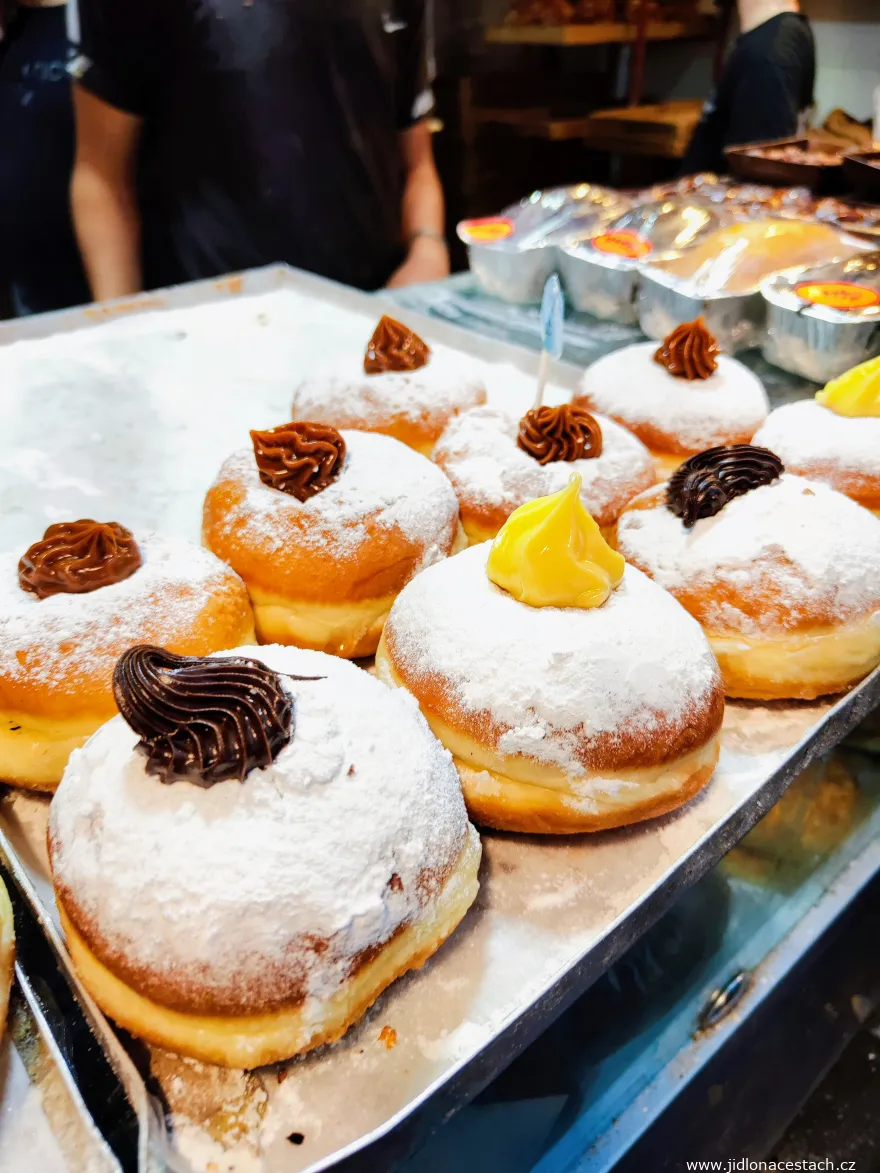
The dough is buttery and yeasted, closer to brioche than to fairground pastry, and it's fried in oil until golden. The filling - classically strawberry jam - is injected into the doughnut only after frying, through a hole in the top straight into the center; all that goes on top is powdered sugar. Alongside the classic, modern bakeries fill them with pistachio cream, salted caramel or nougat; a gourmet doughnut like that runs 15 to 19 shekels, compared with 6 to 9 for the jam one. The jam-filled doughnut I loved so much as a kid back home is a crumb next to the Israeli one - I'd guess a sufganiyah has four times as much dough.
Sufganiyah is a one-holiday food: bakeries roll it out about a month before Hanukkah and pull it a week afterward, and Israel eats most of the season's supply in the holiday week itself. If you fly in during July, you won't see many doughnuts.

The Line Outside the Bakery
I bought my sufganiyot in Jerusalem, at a small bakery whose name I didn't write down, and there was always a line outside. The baker filled the doughnuts with a piping bag right before selling them: the customer would already be holding an open box, and the chocolate went straight in. The dough was soft and airy, and nobody skimped on the cream. A doughnut with vanilla or chocolate filling cost 7 ILS (2 EUR) - a lot by the standards back home, but not much for four times the dough. A hundred years ago the Histadrut wanted to give bakers work; people still stand in line outside bakeries for doughnuts today. The plan worked.


