Varna Farmers Market: The Central Market Locals Call Kolhozen Pazar
The highest number on any price label I photographed at the market in Varna belonged to the one item nobody had sown or watered: rose hips, seven leva a kilo, sitting in a cardboard box next to peaches at two and a half. Before I could work out why wild berries off a bush cost more than orchard fruit, it dawned on me where I was standing.
Varna Farmers Market, officially Pazar Centralen (in Bulgarian Пазар "Централен") and Kolhozen pazar to locals, is the biggest market in the city: several covered lanes of fruit, vegetables, herbs and flowers, a fish market inside and bakeries and cheese shops around the edge - the place where Bulgarian cuisine starts long before it ends up on the stove.

Centralen, Kolhozen and Farmers Market: Three Names for One Market
On paper it's Centralen, on your phone's map it's Farmers Market and to the people of Varna it's Kolhozen pazar, the collective-farm market. The nickname goes back to the days when farming cooperatives brought their surpluses here, and it outlived both the cooperatives and the regime; today the whole neighborhood around it carries the name, schools and nurseries included. The English name on the map is a trap: the real fermerski pazar, a farmers' market of small producers, is held in Varna only on Sunday mornings by Musala Square - a different place on a different day. If you're after farmers on a weekday, you want Kolhozen. Every larger Bulgarian city has a municipal market of this kind. In Varna, Centralen falls under the municipal company Pazari, which runs more than ten marketplaces around the city; Blue Market with its grandmothers selling from their own gardens is a pocket-sized version of it.
What's Sold at the Kolhozen Market
Neither the operator nor the city tourism website says when the market was founded, and I'm not going to guess. It sits in the center between Piskjuliev, Drin and Angel Kanchev streets; in November 2024 some of the stalls got new metal canopies and the city tore down forty-six old pavilions along Piskjuliev Street. The market isn't shrinking - it's just tidying up. The word "farmers" on the map sells the place short: besides fruit and vegetables you'll find meat, fish, clothes, shoes, cosmetics and gardening supplies, so this is a market district, not a handful of tomato stalls. The fish market is right inside the grounds, a corner of its own by the junction of Piskjuliev and Kanchev, and the perimeter is lined with bakeries, shops selling pickled vegetables and shops selling sirene.
Cash is still the safest way to pay at the market. Restaurants are required by law to have a card terminal, a tomato stall isn't, and the ones that do have one hang a little sign next to it with the minimum spend. When I visited I didn't pay by card anywhere and nobody found that odd; at markets in Bulgaria or in neighboring Romania it wasn't the norm back then.
Labels That Say More Than the Price
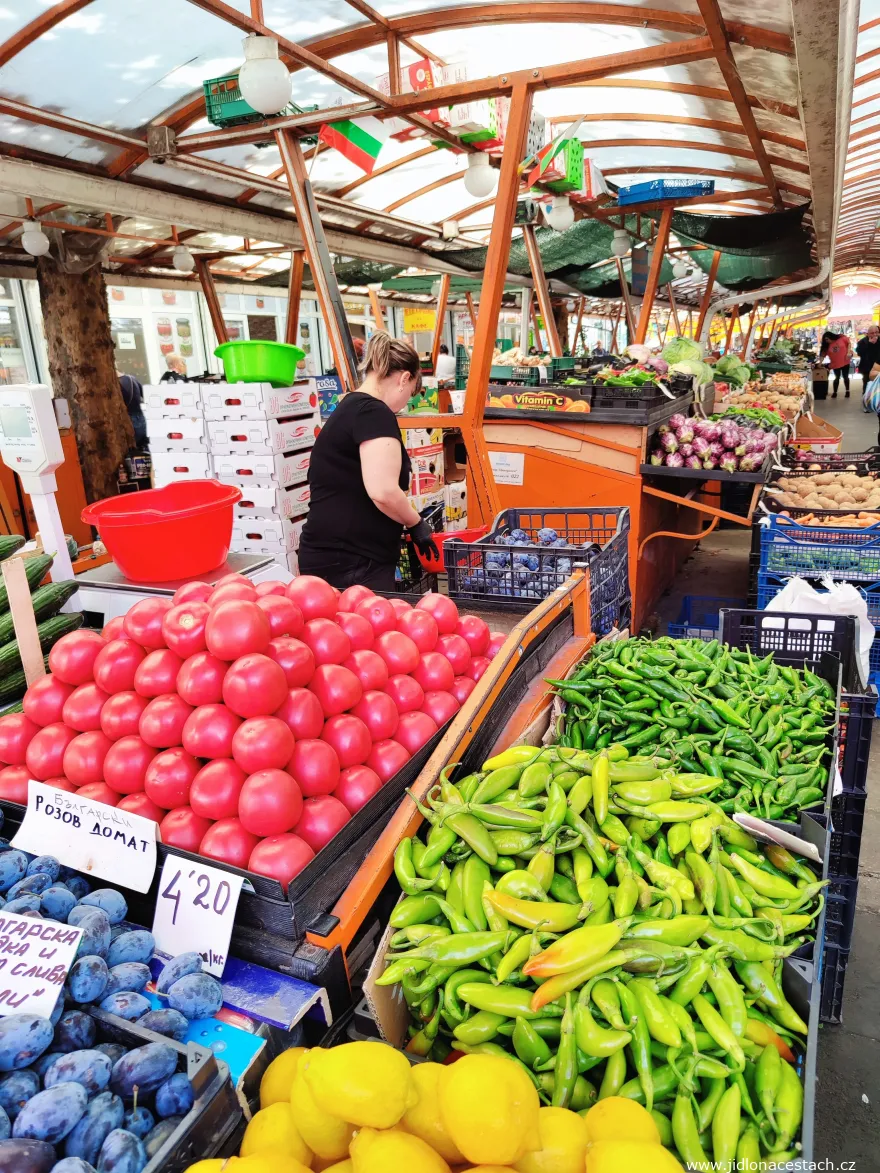
Reading the labels at the Kolhozen market is more fun than reading a menu. A peach here isn't a peach but a "Bulgarian peach", a tomato is "homegrown, from the garden" and the pink one announces itself as a "Bulgarian pink tomato" at almost twice the price of the ordinary kind. The pink tomato is an old Bulgarian variety, not an unripe one; its most famous strain, from Kurtovo Konare, is listed in the Slow Food catalog; it has no official protected designation yet, and the label at the market is already staking a claim to one. The word "homegrown" on a slip of paper is a guarantee nobody checks and everybody believes. And the rose hips? Anyone who has made rose hip jam at home knows what you're paying for. They're picked from September until the first frosts, so a box at the end of September was full of the freshest thing that grows for free.

A Thursday With My Phone Among the Stalls
I walked the market on a Thursday afternoon, bought nothing and nobody minded: the women behind the counters let me photograph pyramids of pears and plums along with the labels and got on with serving the customers ahead of me. Sunshades overhead, a glass roof in one wing with a small Bulgarian flag, and beneath it pink tomatoes and a heap of green peppers. Peaches 2.50 BGN (1.30 EUR), pink tomatoes 4.20 BGN (2.20 EUR) and rose hips 7 BGN (3.60 EUR), all per kilo. I left the market empty-handed with a phone full of photos. That lasted until the first bakery around the corner, where soldiers' cookies and kurabiiki lay side by side.
Farmers Market


