Sirene: Bulgarian White Cheese in Brine
I brought two kilos of cheese home from Bulgaria. Cow's milk, goat's milk, a blend with buffalo milk, each in its own bag with just a splash of brine. I bring cheese back from everywhere, but this one is my favorite edible souvenir from Bulgaria. Sirene (Bulgarian: сирене) is a soft white cheese that ripens and keeps in salt brine - the cornerstone of Bulgarian cooking, and without it there would be no Shopska salad, no banica and no katak. It's made from cow's, sheep's, goat's or buffalo milk, and at breakfast it turns up cut into cubes next to the tomatoes.
Why You Can't Buy "Cheese" in a Bulgarian Shop
A Czech walks into a Bulgarian shop and asks for cheese. Except Bulgarian has no such word - it has two. Sirene is the white cheese in brine, kaškaval the yellow, firmer one that you grate and melt; to a Bulgarian they are two different foods. The word grew out of the Slavic root for "raw" - cheese was what came out of raw milk - and the Czech word sýr comes from that same root. The family stretches across the whole of the Balkans: Greek cooking has feta, Turkish has beyaz peynir, Romanian the firmer telemea, Macedonian belo sirenje and, in Mariovo, also bieno sirenje, where the curd is beaten instead of pressed. What sets sirene apart from feta is mainly the milk - feta may only be made from sheep's and goat's milk, sirene is most often cow's - and it tends to be softer and saltier. So the guidebook shorthand "Bulgarian feta" is about as accurate as calling every white wine chardonnay.

Sofia Cheese in Istanbul and a Stamp Twenty Years After Feta
Who took white cheese from whom is a question the Balkans will never settle, but one document tells us plenty. An Ottoman register from 1502 lists "Sofia cheese" among the cheeses imported into Istanbul as an entry of its own, separate from "white cheese" - so cheese from the Bulgarian interior was already trading under its own name at the start of the 16th century. More recent history was settled by paperwork: Greece protected the name feta in the European Union in 2002, while Bulgaria did not get a protected designation of origin for its white brined cheese until 2023. The definition is strict: milk from Bulgarian territory only, rennet, salt and a mandatory Lactobacillus bulgaricus culture, the same bacterium that made Bulgarian yogurt famous. For years before that, Bulgarian cheese was exported through Greece under a Greek label, because producers were not allowed to sell it in the EU under its own. Today the Greek press complains that Bulgarian white cheese is flooding the market as fake feta. Same cheese, different stamp.

What's in the Bag and What Has to Be on the Label
The recipe for sirene is short, which is exactly why nobody can cut corners without it showing. The milk is set with rennet, the curd is cut, salted and left to ripen in brine, where bacteria break down the lactose and the proteins; salt makes up roughly three to four percent of the finished cheese, and the brine doubles as a preservative, so a bag keeps for weeks in the fridge. The type of milk decides everything else: cow's is the cheapest and the most common, sheep's the most traditional, goat's the most pronounced and buffalo the priciest, at roughly twice the price of cow's, which is why labels often list it as no more than a thirty percent addition. The block of Balkan cheese from the supermarket back home in Czechia, the one we crumble into Shopska salad, is a distant cow's milk cousin - same shape, less flavor. And a practical note on the packaging: in Bulgaria, a cheaper product made with vegetable fat has to carry the words имитиращ продукт, imitation product - and thousands of tonnes of it sell every year. Look for the word сирене with nothing else added to it, and an ingredient list with nothing but milk, rennet, culture and salt.
Sirene turns up from morning to night and in almost every course. On bread with tomatoes in the morning, grated over Shopska salad at lunch, layered into banica between sheets of pastry, mashed into katak with roasted peppers, and in the evening baked in paper with butter and an egg, or in a clay dish po šopski with vegetables. With rakija it arrives cut into cubes - salty damage control.
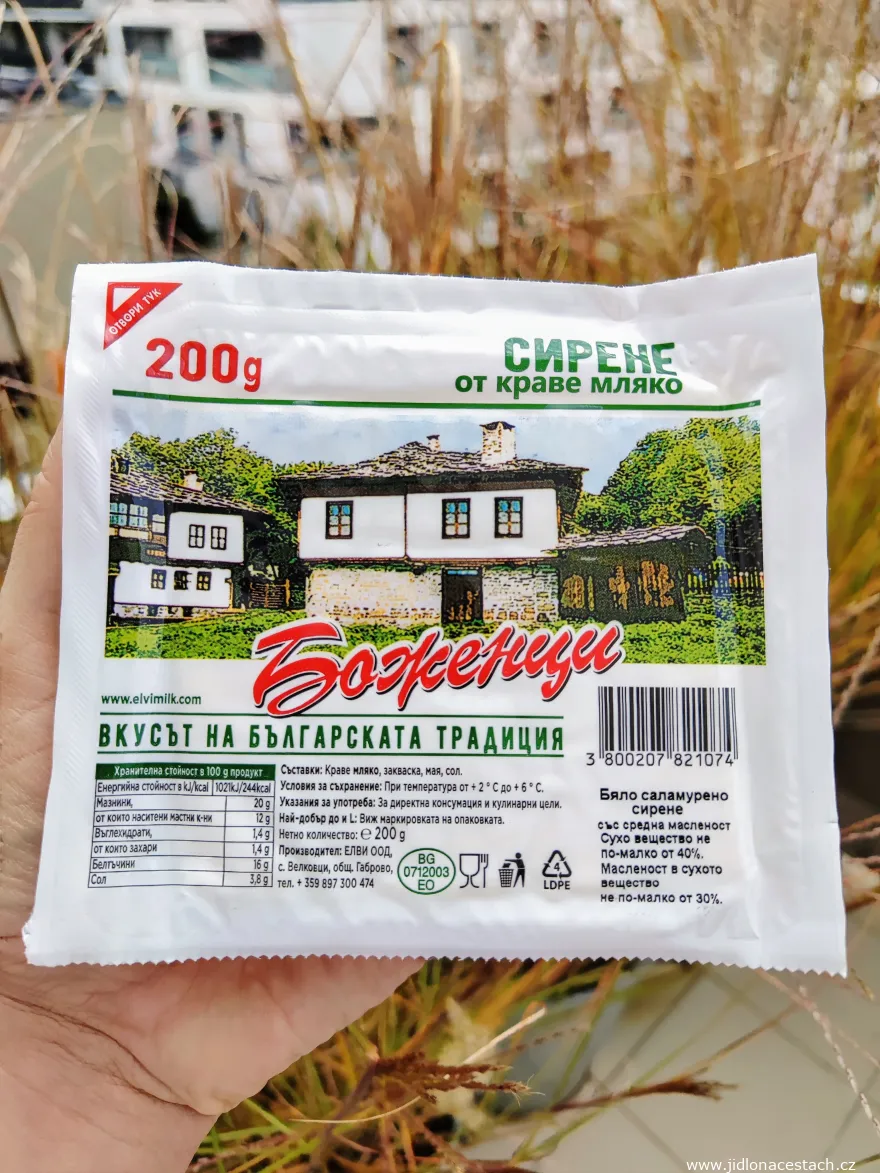
Three Bags from the Supermarket
I didn't buy my sirene at a market or from a farmer, but in ordinary Bulgarian supermarkets, where it takes up a whole wall of the chilled section: blocks of 400 and 200 grams, brands no Czech has ever heard of, and a smaller price gap between cow's, sheep's and goat's than I'd have expected. I photographed three of them at home. The blend of buffalo and cow's milk was the densest and the richest, almost buttery on the tongue. The goat's milk one had the strongest flavor, with a slightly sharp finish. And the cow's milk one surprised me most: it smells and tastes distinctly of good plain yogurt, and that, as I now know, comes down to the same bacterium. Compared with the "Balkan cheese" back home, all three were finer and more interesting. The 400 g pack of the blend cost 11.90 BGN (5.60 EUR), 200 g of the goat's milk one 6.80 BGN (3.20 EUR) and 200 g of the cow's milk one 4.70 BGN (2.20 EUR). Two kilos in a backpack looked like far too much. At home it turned out to be a conservative estimate. I'll have to go back for more sirene.


