Shawarma: Middle Eastern Meat from a Vertical Spit
It turns. A vertical column of meat stands in the window of the stall, rotating slowly around a heating element, and every so often a man with a long knife shaves a few slices off it, the way you'd sharpen a pencil. You'll see that motion on every corner in the Middle East, and the dish is named after it.
Shawarma (Hebrew: שווארמה) is meat marinated in spices, roasted on a vertical spit and shaved into thin slices straight into bread or onto a plate - in Israeli cuisine it sits alongside falafel among the dishes you order through a window and eat standing up.
A Name That Describes the Motion
Shawarma is the Arabic form of the Turkish word çevirme, turning. So the name gives away nothing about the meat or the spices - it describes only that movement on the spit. Neighboring cuisines named the same principle in their own way: Turkish cuisine spins döner kebab, literally "the turning one", Greece has gyros and Mexico tacos al pastor. The Greek branch went its own way after the population exchange with Turkey, and its present sliced form was shaped by the military junta, which between 1967 and 1974 banned roasting ground meat on a spit. The Mexican version came from Lebanese immigrants, who swapped lamb for pork in an adobo marinade; the vertical spit is still called a trompo there, a spinning top. Shawarma simply doesn't belong to any one country - the whole Middle East shares it, from Turkey through the Levant to Egypt.
From a distance all three spits look the same; the difference shows up only on the plate. Döner is the most restrained of the three: the meat - beef, veal or chicken - is seasoned sparingly with paprika, cumin and garlic, and comes with fresh tomatoes and onion, a yogurt sauce and Turkish bread or thin lavash; in Turkey it might just as easily arrive on a plate with rice. Gyros does what's unthinkable to both its cousins - pork - and added tzatziki. Shawarma differs from both mainly in the marinade: cumin, turmeric, cardamom and cinnamon give the meat a yellow color and a sweetly spiced aroma, sesame tahini takes the place of yogurt sauces, and the bread is pita or lafa. Instead of fresh tomatoes, it's pickled vegetables that crunch inside. Three dishes a tourist would confuse and a local never would.
Bursa 1867, Not Constantinople
The vertical spit was set up in Bursa in 1867 by İskender Efendi, a butcher's son who boned the meat and started roasting it upright in front of hot coals instead of flat over the fire. The novelty spread under the name döner kebap, and the Arab world gradually adapted the technique to suit itself. No source reliably pins down when shawarma reached the streets of Israel - and it's more honest to admit that than to borrow a date from somewhere else.
Turkey, Fries and a Drop of Amba
The Israeli version has a style all of its own. While the countries around it put mostly lamb and chicken on the spit, the most popular meat on an Israeli spit is, surprisingly, turkey, marinated in turmeric, cumin, cinnamon and cardamom, which give it both color and aroma. A slab of lamb fat goes on top of the spit: as it turns, the fat drips slowly and bastes the meat below it all shift long. Then two local fixtures: fries tipped straight inside the pita and amba, the tangy, spicy mango sauce that Iraqi Jews brought to Israeli stands and that once sailed to Iraq from India. Not many sides arrive with that many miles behind them.
Shawarma has no set time of day: lunch on a building site and dinner on the way home. You order it in a pita, in a larger flatbread called lafa, or on a plate, and at the counter you point straight away at what goes with the meat: tahini, hummus, pickled vegetables, that amba I mentioned. The mark of a good stand: the spit is shaved down and built back up all day long, and the meat comes to you freshly cut, not reheated from a pile that's been sitting there since noon. Where the column of meat isn't turning, the customers aren't turning up either.
Shawarma from a Bistro That Isn't on Any Map
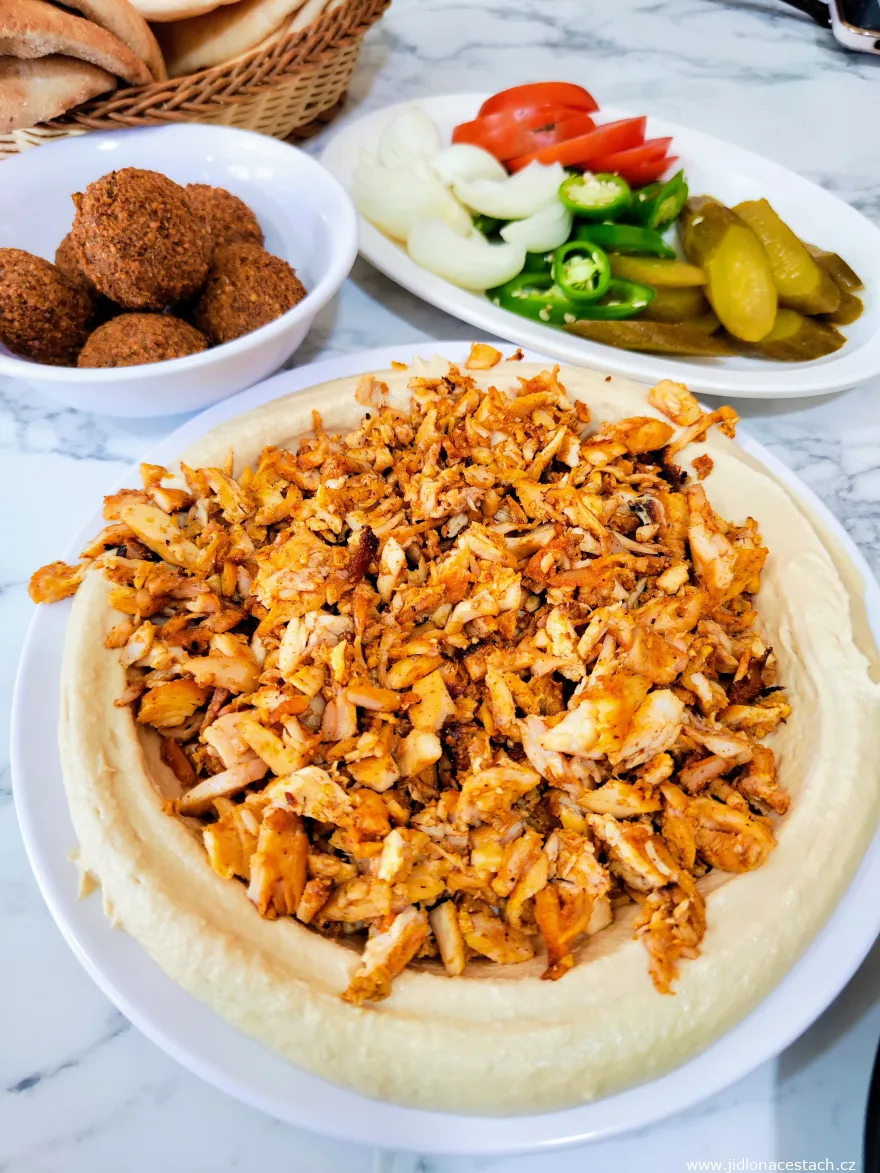
I ate my shawarma in a small bistro that wasn't even marked on the maps - some people would take that as a warning - I took it as a good sign. I ordered the chicken, and what arrived was a feast: slices of meat piled on a layer of hummus, freshly fried falafel, a small plate of raw vegetables and a basket of fluffy pita. The meat had crisp browned edges, a juicy center and a marinade that was more fragrance than fire; the hummus underneath did the work of a sauce. And yet shawarma is a dish designed for one hand and a walk. This portion sat two people down at a table and filled both of them up.


