Pita: The Flatbread With a Pocket to Fill
The most important ingredient in a pita appears in no recipe. It's air. A round of flour, water, yeast and salt goes into an oven so hot that the water in the dough has no time to do anything but turn to steam in a single second, and that steam blows the dough up from the inside like a balloon. When the flatbread comes out a few minutes later and collapses, the steam leaves a hollow behind - and that hollow is why the whole Middle East buys pita.
Pita (Hebrew: פיתה) is a soft, round flatbread with a pocket inside that you only have to tear open and fill, and in Israeli cooking there's hardly a dish you eat with your hands that doesn't involve it.
Where the Word Pita Came From and Who Gave It Back
Anyone who assumes the Hebrew word pita is Arabic has half of Israel on their side - and the Academy of the Hebrew Language against them. Arabic has no "p" sound at all, so the word had to come from somewhere else: from the Greek pitta you know from spanakopita, the spinach pie, and Sephardi Jews from the Balkans most likely carried it into Hebrew. Arabic speakers next door then took the word back and say it their own way - "bita". The language went full circle in a way any diplomat would envy. The bread itself is the same all across the Levant: Lebanese and Syrians call it khubz arabi, Arabic bread, and fill it just like they do in Tel Aviv. The Greek pita under a gyros is a different bread altogether, cooked on a griddle and with no pocket, and the Balkan "pita" is a layered pie; same name, three different dishes. What does have a pocket is Cypriot pita, oval and opened at one end, while Armenian lavash, Iranian taftoon and Iraqi samoon are flatbreads with no hollow - relatives from the same table that simply work a different trick.
Who Shrank the Pita to a Hundred Grams
Flatbread in this corner of the world is older than farming: in Jordan's Black Desert, archaeologists found the charred crumbs of a flatbread that hunter-gatherers baked some 14,400 years ago. What is young is the small pita you get with your falafel today: it appeared in Israel somewhere between the 1950s and the 1970s, at the request of street vendors who found the big traditional Levantine bread too much for a single serving. Bakers still call it "the hundred-gram pita". Who shrank the recipe first is anyone's guess; the sources can only narrow it down to a couple of decades. So Israel didn't invent pita; it just gave it the format the whole world knows today.
How the Pita Gets Its Pocket and Why It Has None in Czechia
There are four ingredients, but the one that decides the outcome is the heat. Flour, water, yeast and salt make a smooth dough that proofs briefly, gets rolled out thin and goes into the oven: traditionally into a wood-fired clay tabun, in an industrial bakery onto a belt where the temperature climbs to four or five hundred degrees. It all comes down to speed - the bread can spend only a couple of minutes in the oven so that the crust seals before the steam escapes and the gluten stretches tight like the wall of a tent. A slow oven gives you bread, a fast one gives you a pocket. The supermarket pita back home in Czechia sits on the shelf next to the tortillas, which is a bit like putting an envelope next to a postcard: one you can fill, the other you can't. And even that envelope is stuck shut after a week in the bag, so you have to dampen it and warm it for a few seconds before the pocket opens again.
In Israel people eat pita from morning to night and with anything: split open and stuffed with falafel, shawarma or the egg and eggplant of sabich, torn into pieces that work as a spoon for hummus. It disappears for exactly one week a year: at Passover, when leavened baked goods are banned and the Matzot Festival Law names pita explicitly, right after bread and rolls. At a falafel stand you get the question that matters more than the sauces - "pita or lafa?" Lafa is a bigger flatbread with no pocket, filled and rolled up like a strudel, and anyone who wants plenty of filling and little bread answers pita. One small thing worth knowing: a fresh pita bends instead of breaking, and the pocket opens with a single push of your thumb.
Pita With Everything I Ate in Israel
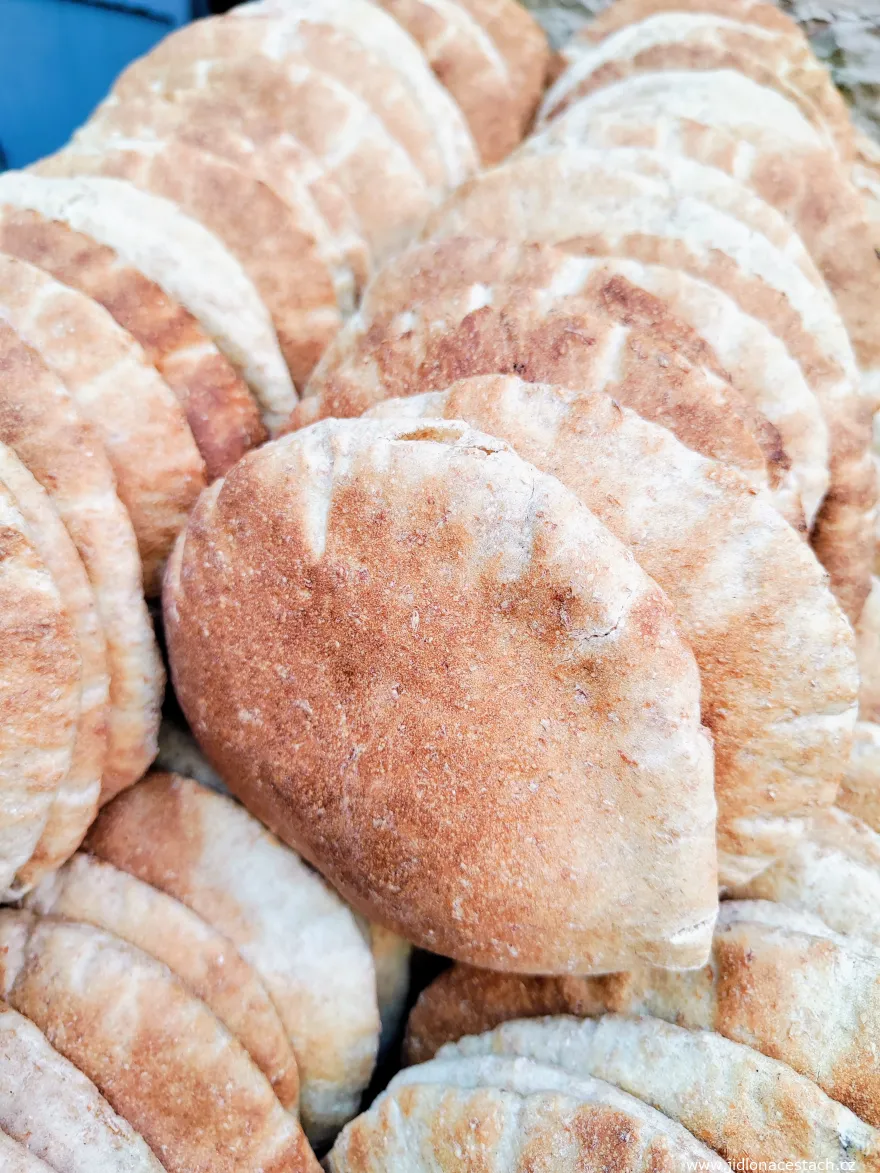
In all my travels around Israel I never once ordered a pita, and yet I ate one every day. It came with a bowl of hummus at the Ben-Sira bistro in Jerusalem (see Where to Eat in Jerusalem), puffed up and still warm; it wrapped both sabich and shawarma, and in the shops it sat packed a few to a bag for a couple of shekels. Fresh from the bakery it smelled of wheat and a little of smoke, the surface lightly floured and under it a soft, supple crumb that tore without crumbling; the old one out of the pack was mostly just dry and gave up its pocket only after some coaxing. The best one was the one I never even thought to photograph - torn off, loaded with hummus and eaten before I could get my phone out.


