Sochnik: The Quark Half-Moon from Soviet Canteens
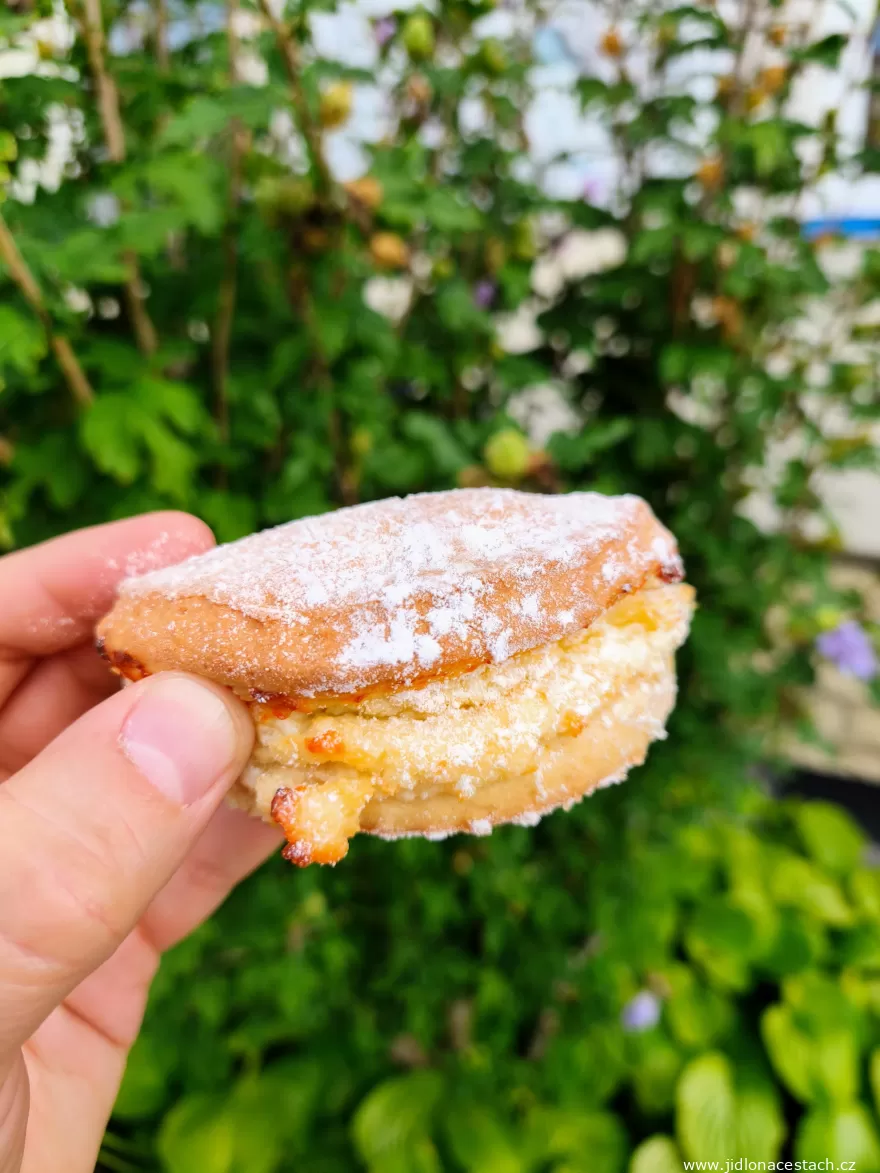
Romanian recipes file it under Russian cuisine - and they're right. Still, in Chișinău the sochnik sits in supermarkets among the in-house baked goods, and I also saw it at the stalls around the central market. Sochnik (Russian: сочник) is a small pastry of short dough folded in half over a quark filling that peeks out of the open edge - a legacy of Soviet canteens that has made itself at home in Moldovan cuisine. It only learned Romanian here - on the label, at least.
Where the Sochnik Gets Its Name and Who Bakes It
Folk etymology links the name to the Russian word for juicy - a bold reading for a pastry that is short and crumbly more than anything else, and a wrong one too. It's named after an old flatbread called sochen, brushed with "juice" pressed from hemp seeds - in other words, hemp oil. And that flatbread had the kind of career today's little pastry can only dream of: it was baked on Christmas Eve, and the Russian name for Christmas Eve, sochelnik, still comes from it. Sochen dough was supposedly even made into a mask: over the holidays, people looked through it to tell fortunes from the first passer-by. In short, the sochnik is a pastry whose ancestor gave its name to a holiday.
It belongs to the whole post-Soviet world: its heartland is Russia and Ukraine, and Moldova adopted it without a variant or a name of its own - Romanian most often simply borrows the Russian plural, sociniki.
A Round of Dough, Quark and a Spoonful of Semolina
The base is a round of short dough made with sour cream, roughly the size of your palm. One half gets quark beaten with sugar, egg and semolina, which holds the filling together so it doesn't run during baking; the other half is folded over it, the edge is left slightly open and the top is brushed with egg yolk - the ones I bought in Chișinău got a dusting of powdered sugar instead. The canteen standard was precise: a circle ten to twelve centimeters across, with the finished piece weighing around eighty grams. Its present-day form was shaped by Soviet canteens, where quark became the only conceivable filling, and recipes still circulate with the tag "po GOSTu" - made to the state standard, though nobody has ever shown that one exists for the sochnik. It's a nostalgic label, not a regulation: it simply means "just like back in the canteen."
People eat it cold, with tea or coffee, and since Soviet times it has been a snack-time pastry: it was sold in school snack bars, and in Moldova people remember it as a student staple of the seventies - dirt cheap and washed down with kompot, a sweet drink of stewed fruit. Quark has other homes in Moldovan cooking, too - Moldovans just prefer to wrap it in boiled colțunași dumplings; the sochnik is simply the quickest way to eat it on the go. And don't leave it in a closed box - the pastry draws moisture from the filling and goes soggy.

Five from the Supermarket
I bought my sochnik - five of them, to be exact - at the Nr.1 supermarket in Chișinău: a pack from their own bakery cost 39.60 MDL (1.90 EUR), which works out at 7.92 MDL (0.40 EUR) apiece. I took them along as a snack for the plane. They weren't as dry as you might expect from crumbly pastry. The quark and the pastry reminded me faintly of the quark koláče we bake back home in Czechia - just without the plum butter on top. Part of the pack was gone before we landed, and the rest made it home with me. Mind you, the label gave the sochniki a shelf life of just 24 hours - a pretty strict deadline for a genre that calmly outlived the entire Soviet Union.


