Supra: The Georgian Feast
There's one vessel that has never heard of "just a drop": a hollow horn called kantsi. It has no flat bottom, so you can't stand it on the table - until you've emptied it, you're holding it, and the whole table is watching. Few cultures have written their drinking rules into their tableware more thoroughly.
Supra (Georgian: სუფრა) is the great Georgian feast: a table laid with every dish at once, wine instead of water, and toasts in a fixed order, presided over by an elected speaker called the tamada. The whole of Georgian cuisine turns up on it at once - but you may only drink once the tamada has finished.
What Supra Means and Who the Tamada Is
The word supra literally means tablecloth, a laid table. Georgians borrowed it from the Persian sofre, and the Persians most likely have it from Arabic, where a related word meant the food a traveller packs for the road. So the most Georgian term you'll hear in Georgia is a loanword - which doesn't stop anyone from treating it as the family silver. The feast is led by the tamada, appointed by the host or voted in by the table: he delivers the toasts, keeps them in order, reins in the drinking pace, and at long wedding tables he names deputies for the far ends. When he hands the floor to a guest to take a toast further in his own words, that's called alaverdi.
Toasts run by a master of ceremonies aren't a Georgian monopoly, though. The feast with a tamada is at home across the Caucasus - in Armenia the very same figure runs weddings and celebrations - and the Soviet era then carried the tamada into every republic, where the stern conductor of toasts eventually shrank into a wedding host with a microphone. Turkish cuisine raises a glass with a cry of şerefe, but nobody there runs the evening. Supra remains the most elaborate version of Caucasian dining: a feast promoted to an institution with a protocol of its own.
The Statuette from Vani and the UNESCO Myth
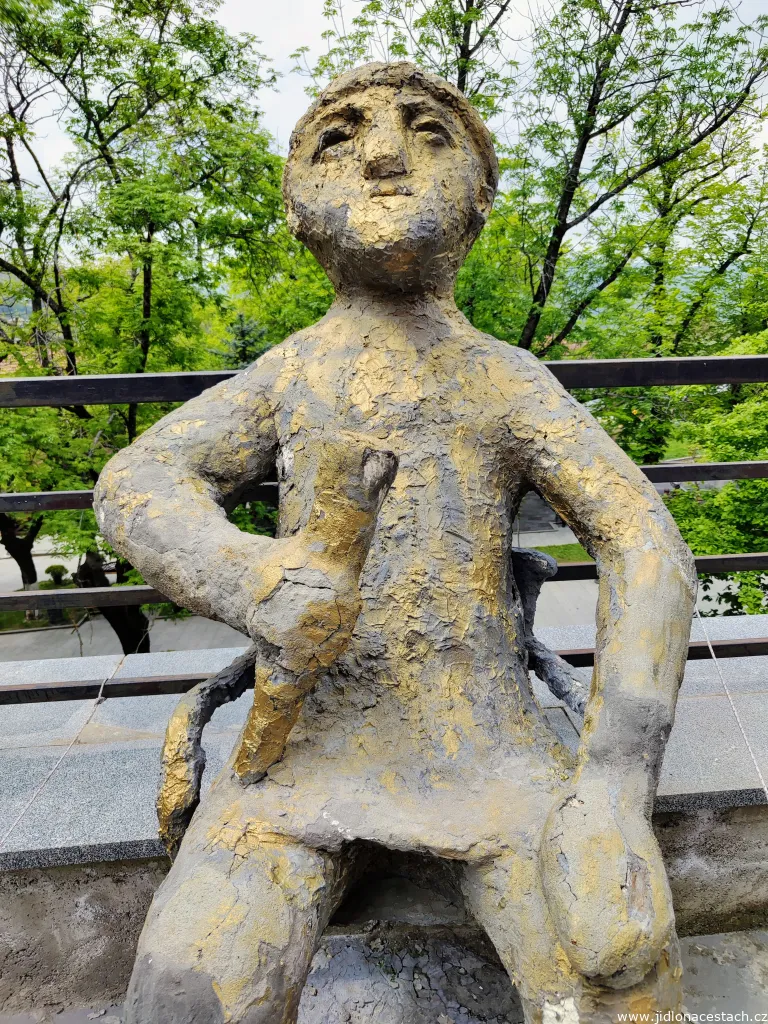
You can see just how old the ritual is in a bronze statuette of a man with a drinking cup, dug up at Vani in the west of the country and dated to the 7th century BC - copies of it turn up all over Georgia today as statues and souvenirs, and locals see in it the forefather of every tamada. Rustaveli's 12th-century epic describes the culture of feasting as well, and later so did the notebooks of European travellers. There is one thing the world has added to supra all by itself, though: the feast is NOT on the UNESCO list. Since 2017 it has been a protected entry on Georgia's national list of intangible heritage; what sits at UNESCO for Georgia is polyphonic singing and winemaking in qvevri clay vessels. Half the travel websites out there put supra on the UNESCO list. The mistake is so widespread that you'll hear it repeated in Georgia itself.
How a Supra Runs and What Gets Eaten
Everything comes to the table at once and then stays there: khachapuri, khinkali meat dumplings, mtsvadi skewers, pickled vegetables, cheeses, bread, quite possibly a beef stew called ostri - the plates pile up in layers and nobody takes them away. Wine is what you drink, with the grape spirit chacha to finish if the evening asks for it. But the heart of a supra isn't on the plates. The main course is delivered standing up: the toasts come in an unchanging order - God, family, homeland, ancestors - and only then does the floor open up for friendship, love or peace. Between toasts nobody drinks; taking a sip on your own is roughly the same faux pas as cutting in on a speaker at a wedding. The difference being that here the speeches go on all evening, and a festive supra can stretch on for hours. And it isn't always a cheerful affair: after a funeral there's a more modest mourning version called kelekhi.
Two Supras and One Buffalo Horn
I've been through a supra twice. The first time in its symbolic form, staged for guests on a Georgian wine tour: once the toast had been made I was handed a buffalo horn and quickly grasped why you can't put it down - the wine ran out of it more willingly than I could swallow - and then, all at once, the bottom. The second time an unstaged supra with a charismatic tamada caught me by chance in a beer hall in Kutaisi. I understood almost nothing, and still I listened as intently as the locals did; the drinking was frequent, heavy and always down to the last drop, so the day after a supra can begin with a nasty headache. Even so, sitting through a real supra remains one of my strongest memories of Georgia. A kantsi may only be set down when it's empty. Georgia let me go home much the same way - only once I'd had my fill of it.


