Cozonac: Romania's Sweet Holiday Bread
The oldest surviving Romanian recipe for cozonac opens with twenty-one eggs. It goes on to three kilos of flour and three liters of melted butter, and it never bothers to say how many people are supposed to eat it - in 1841 that clearly went without saying.
Cozonac is a festive bread of rich yeast dough that Romanian cuisine fills with walnuts, cocoa, poppy seeds or raisins, rolls into a spiral and bakes in a loaf pan; it is cut into slices like bread and it sits on the table at Christmas as well as at Easter. The eggs have thinned out since. The expectations haven't.
The Little Doll That Traveled North
The name is a birth certificate, only this one was issued abroad. Romanian dictionaries trace cozonac to the Modern Greek kosonáki, a diminutive of kosóna, a doll - the rolled loaf was said to look like a figure wrapped in swaddling clothes. The word then traveled on north: Bulgarian linguists say their kozunak borrowed it from Romanian, not the other way around, even though it sounds as if the Balkans had it first. It's pronounced ko-zo-NAK, with the stress on the last syllable.
Cozonac is typically Romanian and Moldovan, but it belongs to a family that covers the whole southeast of Europe. In Bulgarian cuisine they bake kozunak for Easter only, never at any other time, and braid it; Greek tsoureki smells of mahleb and mastic and carries a red egg baked into the top; the Italian panettone is taller, airier and has no filling inside at all - its candied fruit is scattered through the dough. What sets Romanian cozonac apart from all of them is that the filling is rolled inside like a spiral, and that no single holiday owns it: it gets baked for Christmas, for Easter, for weddings, and for no reason at all, just because it happens to be Sunday.
The Bread That Became a Dessert Only Under Communism
As late as the 1930s Romanian dictionaries still listed it as a kind of bread, with no mention of a filling; it turns up as a dessert only in editions published after 1960. So cozonac became a dessert on paper at roughly the same time as home cooks were turning it into an ever richer cake. Romanian cooking websites like to place its cradle in ancient Egypt, but that is the all-purpose legend about honey bread, and it fits every sweet baked good in the world; anyone looking for a documented origin ends up at the 1841 cookbook of Kogălniceanu and Negruzzi. It was written for boyar households, and in it cozonac was eaten with everything, with soup and with a roast - today you eat it on its own and it is cut at the table.
What Goes into Cozonac and How to Spot a Good One
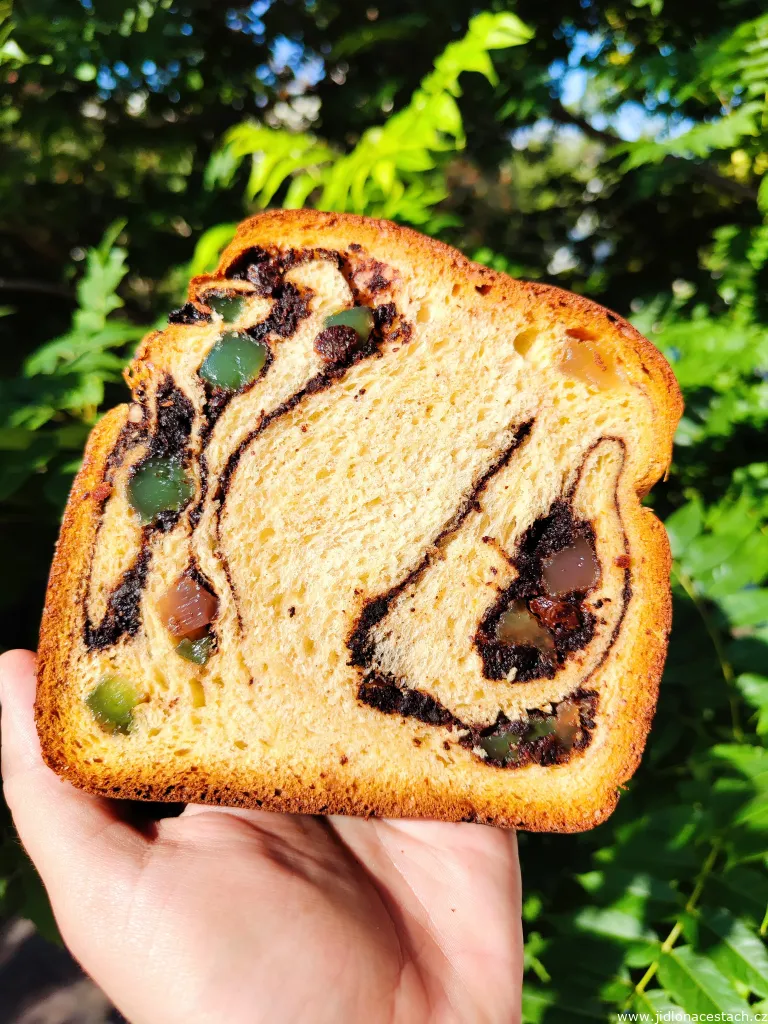
The rich dough is what matters: flour, milk, plenty of egg yolks, butter and yeast, with lemon zest and vanilla, and in the Moldovan version a trick with scalded flour that keeps the loaf soft even on the fourth day. The filling is secondary, and every region has made it its own - walnuts with cocoa, poppy seeds, raisins, and since the 1990s also rahat, cubes of Turkish delight that come across today as an age-old tradition but appear in no Romanian recipe before 1990. Once it comes out of the oven, cozonac should look like the sweet braided loaf we bake back home for Christmas, except that instead of a plait it has the filling coiled inside; and above all it is not meant to be cut, but torn. A good cozonac tears along the grain, into long strips like rope - Romanians call it se rupe în fâșii, and it is the most reliable test you can run in a bakery with your bare hands. Industrial cozonac made with margarine just crumbles.
It is baked at home, at a family occasion run by mothers and grandmothers, and it follows rules that sound like superstition but are laws of physics: the kitchen door stays shut so no draft reaches the dough while it rises, and the oven stays closed for the first twenty minutes, or the loaf sinks. Anyone who doesn't bake buys it at a cofetărie or at a bakery, where they slice it and sell it outside the holidays too. Supermarket cozonac, thrown together from margarine in a couple of hours, is not the one this article is about.
A Slice in Hand in Iași
I ate cozonac in Iași, straight from my hand, in the sun, as a snack - one thick slice with a dark filling that somebody had stirred green and amber cubes of rahat into. The dough tore in layers, the way it should, and it was only mildly sweet; the sweetness came from the rahat, which stuck to my teeth in the heat like a gumdrop, while the dark cocoa filling between the layers was faintly bitter and evened that sweetness out.


