Spanish Breakfast: Tostada, Churros and a Beer at Ten in the Morning
The finest room I've had breakfast in anywhere in Spain has a ceiling from 1903, walls lined with Mudéjar tiles and the name of another city: Café Iruña in Bilbao is named after Pamplona, because Iruña is what the Basques call it. Onto the marble counter in a setting like that comes a breakfast that would fit in the palm of your hand: one slice of toasted bread, tomato, a few slices of ham. Nothing else is coming, and nobody here considers that modest.
Spanish breakfast (in Spanish: desayuno) is the smallest meal of the day in Spanish cuisine: toasted bread with olive oil, tomato or ham, a coffee with milk and often a glass of freshly squeezed orange juice. The sweet side runs to churros with thick chocolate and pastries from the bakery, the savory side to tortilla and sandwiches. What nobody eats for breakfast is tapas and hearty plates; Spain saves those for later.

Tostada with Tomato: Bread, Tomato and an Argument About How to Get One onto the Other
The basic breakfast takes three words to order: tostada con tomate. Toasted bread with tomato on top, olive oil and salt; if you want more, you add ham or cheese, and if you want less, you say media tostada and get half of one. Catalans call it pa amb tomàquet and they don't spread the tomato with a spoon but with a halved tomato, rubbing it against the crust until all that's left in their hand is the skin; in Andalusia and Madrid they grate the tomato and spread it. It's one dish, two techniques and one permanent argument about who came up with it. Catalonia holds the oldest written record, from 1884, when Pompeu Gener sat in Paris writing verses about the food he missed from home; historians put the origin in the 18th century, on country farmsteads where tomato was used to soften hard bread. And in 1984 the photographer Leopoldo Pomés devoted a whole book to it, "Theory and Practice of Bread with Tomato", so a dish of two ingredients has a theory of its own. Anyone who has ever sliced an August garden tomato onto a piece of bread and salted it knows that taste; the Catalans just left out the knife.
The bread changes with the region. In Andalusia it gives way to the mollete, a flat soft roll named after the word muelle, soft; the mollete from Antequera has held a protected geographical indication since 2020, and in Cádiz and Malaga they spread manteca colorá on it in the morning - lard colored with paprika and shot through with threads of meat, a breakfast the rest of Spain barely knows about. And yet I didn't get my mollete with tomato and ham in Andalusia, but in a bistro in Haro in La Rioja, at the opposite end of the country - with a coffee with milk and a small glass of orange juice for 4 EUR. I write about the oil elsewhere (see Spanish olive oil); here it's enough to know that without it a tostada isn't complete.

Tortilla, Bocadillo and Bikini: A Savory Breakfast in Your Hand
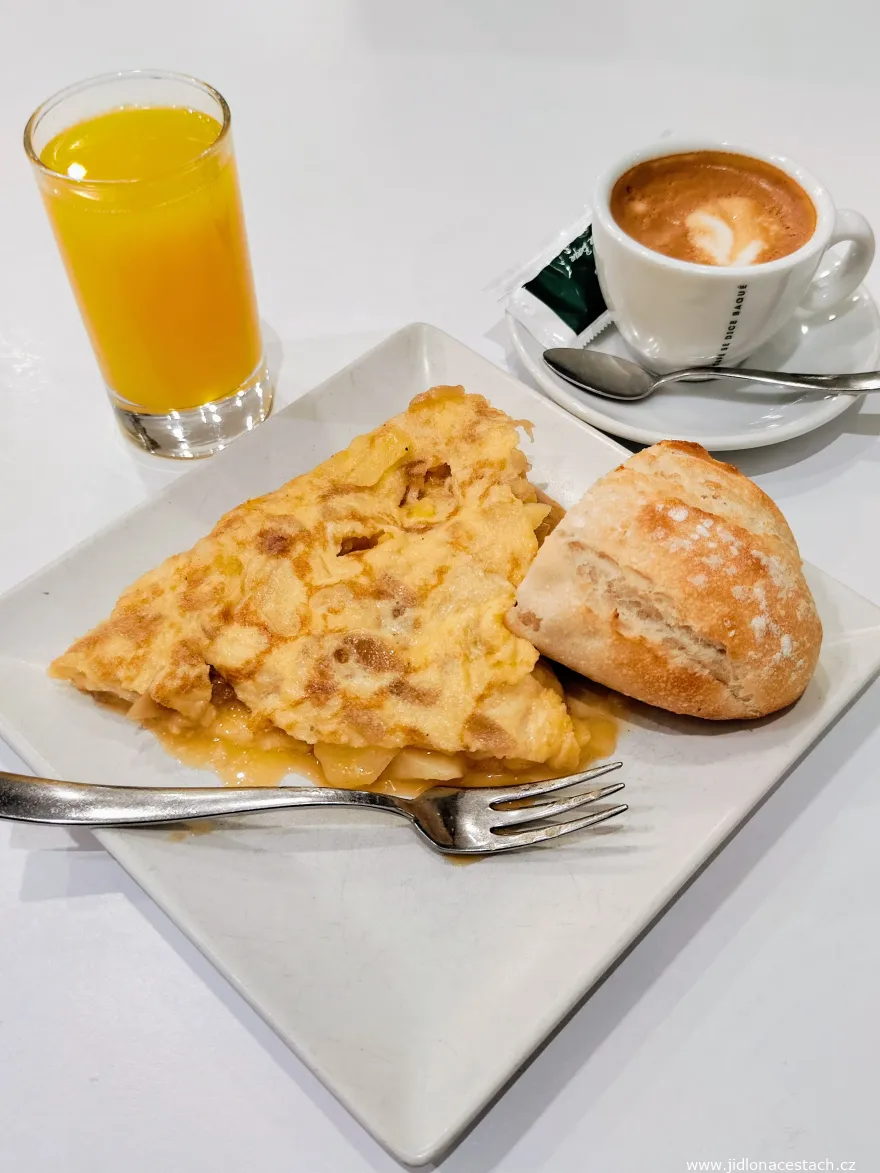
If you want something more solid for breakfast, you point at the tortilla de patatas on the counter, the potato omelet that sits there cut into wedges from the morning on, and nobody would dream of reheating it. A wedge of tortilla with a piece of bread is as ordinary a Spanish breakfast as a tostada, just more filling; in the bistro in Haro it cost 1.80 EUR, and the filled versions, with mushrooms and garlic aioli for instance, a little more. There's a separate article on this site about the argument over whether onion belongs in a tortilla; I like it best when the middle is still a little runny.

The bocadillo is the Spanish sandwich: a length of white barra baguette split lengthwise and filled with whatever is at hand, most often ham, cheese, a slice of tortilla or tuna. In Madrid a small bocadillo the width of five fingers is called a pulga, a flea; in Catalonia every sandwich is an entrepà. So far I've only come across half-meter bocadillos at markets, where they mainly work as advertising: a half-meter sandwich catches the eye and gets shared between several people. Next to the bocadillo on the counter sits a toasted ham and cheese sandwich, called a bikini in Barcelona. It has nothing to do with swimwear: it got its name from the Sala Bikini dance hall on Avenida Diagonal, opened in 1953, where it was served and where guests picked up the name along with the sandwich. The rest of Spain calls it, more matter-of-factly, a sándwich mixto, and the French would recognize their croque monsieur without the béchamel - which is a bit like recognizing bruschetta in a tostada: the outline fits, the difference is in what you do with the tomato.

Churros with Chocolate: A Sweet Breakfast That Isn't Dessert
The sweet side of the Spanish breakfast starts in a churrería. Churros are sticks of dough made from flour, water and salt, piped through a star nozzle into hot oil; porras are their thicker, softer cousins, raised with yeast. They come with a cup of chocolate so thick the stick stands up in it, and there's only one ritual: dipping. Churros are breakfast and an afternoon snack, not a dessert after lunch. The most famous address is Chocolatería San Ginés in Madrid, in the passageway behind the church of the same name: an inn from 1890 turned into a churrería in 1894, and in the 1920s people called it "El Maxim's golfo", roughly Maxim's for night owls, because once the cafés at Puerta del Sol closed, it was the only place still lit. A cup of chocolate with six churros cost 5.90 EUR there. If you want something lighter than fried dough with your chocolate, you get soletillas, sponge fingers known in Catalonia as melindros; they get dipped the same way.

Napolitana, Magdalena and What's in the Bakery Window
The other sweet route leads to the bakery, where the pastries are known collectively as bollería. The napolitana is a rectangle of puff pastry with chocolate that a Frenchman would call a pain au chocolat; there's no evidence the name has anything to do with Naples, and bakers don't agree on where it came from. The almond croissant is a French guest that has made itself at home here. And the magdalena, sometimes described as shell-shaped, looks nothing like a shell: the shell shape belongs to the French madeleine baked in a metal mold, while the Spanish magdalena is baked in a paper case and comes out looking like a small muffin with a dome on top. In the window of a Basque bakery there were also a buttery bollo de mantequilla and a pastel vasco, a little cake filled with custard, at around 2 EUR apiece. The numbers don't flatter the bakery, though: according to a study by Spain's agriculture ministry, tostada with coffee still leads at breakfast, with sweet pastries and cookies behind it, and according to the ANIBES nutrition study only a quarter of Spaniards eat enough in the morning for it to count as a complete breakfast. The small breakfast has the numbers on its side.

Café con Leche, Orange Juice and a Beer at Ten in the Morning
A tostada comes with café con leche, strong coffee with milk in a small cup, and if you're lucky a zumo de naranja natural, juice squeezed from oranges in front of you. Children and a fair number of adults have ColaCao for breakfast, a cocoa powder from Barcelona that two brothers-in-law launched in 1946 as nourishment for post-war children and that is still fighting it out in Spanish kitchens with Nestlé's Nesquik, seventeen years its junior on the Spanish market. And at ten in the morning, beer turns up at the bar. In the Basque Country I saw locals with a small beer, a zurito, or a glass of wine next to their morning plate so often that I assumed it was a Basque peculiarity. It isn't: a bocadillo with a glass of beer on the mid-morning break is a habit of Spanish workers, not a Basque invention. In Valencia the second breakfast even has a name, esmorzaret, and rules of its own - you start with a beer or wine cut with lemon soda, coffee comes only at the end, and anyone who orders it straight away gives themselves away - and Bavaria arrived at the same idea with white sausage and wheat beer. Europe drinks more in the morning than it likes to admit.

Two Breakfasts and One Tostada in Bilbao
The Spanish day has two breakfasts. The first, desayuno, gets dealt with at home or standing at a counter on the way to work, and it tends to be coffee and not much else; the second, mid-morning one is the almuerzo, the one with a tostada, tortilla or bocadillo, and it is often the first meal of the day eaten out. According to an industry survey, 81% of Spaniards eat breakfast out at least once a week; here the bar is part of breakfast. Watch out for the word almuerzo: in most of Spain it means lunch, in Valencia the second breakfast, so an invitation to almuerzo at eleven isn't a mistake, just a different region. And tapas are not breakfast food; those wait until the evening.
My grandest breakfast was in Bilbao, at Café Iruña across from the Jardines de Albia park (see Where to Eat in Bilbao), a café that Severo Unzue opened in 1903 and had decorated like a Mudéjar palace. I had the tostada with tomato and jamón ibérico, the pricier of the two hams, and I could tell right away: bread crisp only on the surface, the tomato cold and sharp under warm ham whose fat had started to melt on the bread before I was halfway through, and salt that needed no adding. It cost 2.80 EUR, a little more than elsewhere, and the bill barely charges you extra for that ceiling. That seemed fair to me: the interior is Iruña's own, the food the same as at the counter in Haro. The palace belongs to Bilbao. The breakfast belongs to all of Spain.


