Churros: Spanish Fried Dough Dipped in Hot Chocolate
Churros are long ridged sticks of choux-style dough made of flour, water and salt, piped straight into hot oil and dipped in thick hot chocolate - the best-known breakfast in Spanish cuisine. Breakfast, not dessert.

What Churro Means and Where It Gets Fried
When a Spaniard says a job came out like a churro (salir un churro), he isn't bragging: it means botched work. The same word in the phrase como churros means the exact opposite, quickly and with no effort, because churros come out of the press by the meter. There are two stories about where the name comes from. The popular one says the sticks look like the twisted horns of the churra sheep; the linguist Joan Corominas traces the word to the root churre, thick greasy fat, and the sheep only comes into it through its coarse, greasy wool. The romantic version has the horns, the documented one has the grease - with fried dough, both fit.
Churros are eaten all over Spain, they just go by a different name in every region. Madrid has thin ridged churros and thicker, fluffier porras (literally clubs), in Andalusia they shape rings of leavened dough called tejeringos or calentitos. Across the border, the family gets bigger: Portuguese cuisine fries thick spirals called farturas at fairs and dusts them with cinnamon sugar, and Latin America fills its churros - in Argentina with dulce de leche only since the late seventies, so the local "age-old tradition" is old enough to remember disco. Chinese youtiao, savory sticks, look exactly like churros, but nobody has ever proven a connection; in China I happily ate them for breakfast and Spain never once crossed my mind.
Shepherds in the Mountains and an Arcade in Madrid
The story goes that churros were first fried by shepherds up in the mountains, men who were a long way from a bakery and never far from a pan. It's the version you hear most often and there isn't a shred of evidence for it. The documented history of churros doesn't begin until the cobbled streets of late 19th-century Madrid, when street stalls turned into permanent churrerías. Chocolatería San Ginés opened in 1894 in the arcade between Calle Mayor and Calle Arenal, and Ramón del Valle-Inclán called it a "buñolería modernista" in his play Luces de bohemia. The second big leap happened a long way from Spain: in 1985 food service manager Jim Lowman brought a churro cart to Disneyland, stretched the sticks to thirty centimeters and sold out on the first day. The record churro now measures more than a hundred and fifty meters, and it was fried in Florida, not in Spain.
Why a Churro Is Star-Shaped and Why It Isn't a Dessert
The dough is almost touchingly poor: flour scalded with boiling salted water, no eggs, no butter. Anyone who makes choux pastry at home knows the method - a churro is the relative that couldn't afford the eggs. The star-shaped nozzle on the press has a job to do: a smooth cylinder of dough would fill with steam in the oil and burst, while the ridges give the steam a way out and the fat a way in. The sweetness comes only with the chocolate a la taza, which is far too thick to drink.
Churros belong to the morning: to breakfast at the weekend, to the afternoon merienda and to the morning after a night that ran long - for mornings like that, San Ginés is open twenty-four hours. Never look for churros among the desserts in a restaurant - if you find them there, the kitchen is cooking for tourists, and that goes for the rest of the menu too. You order a portion and a cup of chocolate; if you want a thicker, softer bite, ask for porras. I write about what else Spaniards drink in the morning in the articles on coffee in Spain and on the typical Spanish breakfast.
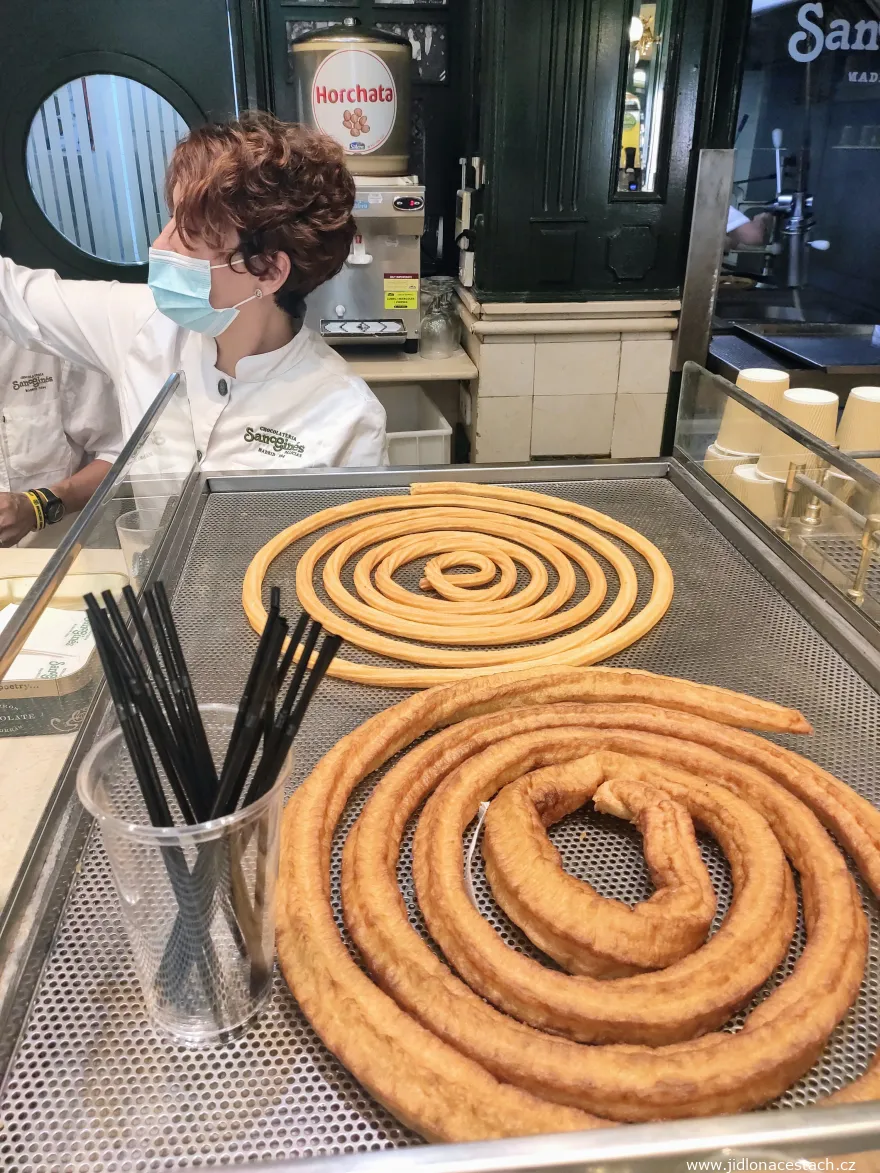
A Portion in the San Ginés Arcade
I ate churros in Madrid, at Chocolatería San Ginés (see Where to Eat in Madrid), where a thin coil of churros and a fat coil of porras lie side by side on the counter and more keep piling up from the press at a pace that explains the idiom como churros better than any dictionary. The surface crunched along the ridges and snapped, the inside was soft and almost bready, the dough itself barely sweet at all; the sweetness and the aroma came from the chocolate, as thick as lukewarm pudding - after the second churro there was nothing left to dip into. I've eaten churros many times on my travels around Spain and these were the best. A portion with a cup of chocolate cost 4.50 EUR.


