Hakien: The Mauritian Twice-Fried Roll
Most fried rolls around the world have one wrapper. Hakien has two, three in some cooks' hands, and Mauritians can't even agree on what's underneath them.
Hakien is a fried roll of finely chopped chicken or shrimp and vegetables, dipped in a thin batter and fried twice to build a thick, rippled crust - street food that Mauritian cuisine picked up from Chinese immigrants and sells at stalls all over the island. At first glance it looks like a fat spring roll. After the first bite, all that's left of the comparison is the filling.

A Dish Named After Guests
It's named after the people who brought it. Hakien comes from Hakka, the Chinese group whose name literally means "guests" - in Mauritius the Hakka make up most of the Chinese community, and hakien is the dish named after them. Nobody has really worked out where the second half of the word comes from; in southern China the word for a roll is romanized much the same way, and the Indonesian bak kien carries the same ending - only that's a different roll from a different diaspora. The spelling is consistently hakien, without the double k that the community's name would call for.
To be fair, hakien is a Mauritian thing, not a Chinese one: nobody in China sells it under that name, and neighboring Réunion has never heard of it either, even though it otherwise shares fried mine frit noodles with Mauritius, along with close cousins of boulettes dumplings. The closest cousin lives in Singapore and Malaysia and is called ngoh hiang: a meat roll from southern Fujian, wrapped in bean curd skin, seasoned with five-spice powder and fried once. The Vietnamese nem comes in rice paper and is fried once, the Filipino lumpia in a thin wheat wrapper. Hakien is the only one in the family that doesn't buy its wrapper - it mixes it.
Who Brought Hakien and Who Gave It a Second Crust
The first Hakka sailed into Mauritius in July 1860 from Singapore aboard the Ville de Paris, seven of them. From 1875 onward they came in the hundreds, mostly from around Meixian in Guangdong province, where the countryside wasn't safe after the Taiping Rebellion was put down, and they opened village shops all over the island. When the first hakien was fried in one of those shops, and why it got a second layer of batter, nobody has pinned down - this is a dish of family kitchens, not chronicles. Only one thing is certain: no Sino-Mauritian New Year table is complete without it. The rest of the year it's an ordinary gajak, the island's word for anything fried you can buy at a window and eat on the spot.
What's Inside and What Comes With It
The filling is the quieter part: finely chopped chicken or shrimp, cabbage, carrot, mushrooms and in some places bamboo shoots, seasoned with soy sauce, fish sauce and garlic, nothing spicy. The argument starts with the wrapper. Half of Mauritian recipes wrap the filling in rice paper, the other half in dough they roll out themselves or in a spring roll sheet - and then they all end up in the same place: the roll goes into a thin batter of flour, water and oil, gets fried, cools down, goes back into the batter and is fried a second time. The yellow food coloring that plenty of recipes add to the batter turns the crust golden before the oil has a chance to brown it.
You eat it hot, off a piece of paper or straight out of your hand, usually with chili sauce; fried gajaks also come with garlic water to dip anything you want to give more of a kick. You buy them by the piece and they taste best while still warm - that's the one rule the island agrees on when it comes to hakien. If you want to be sure of getting one, go in the morning, while they're still frying.
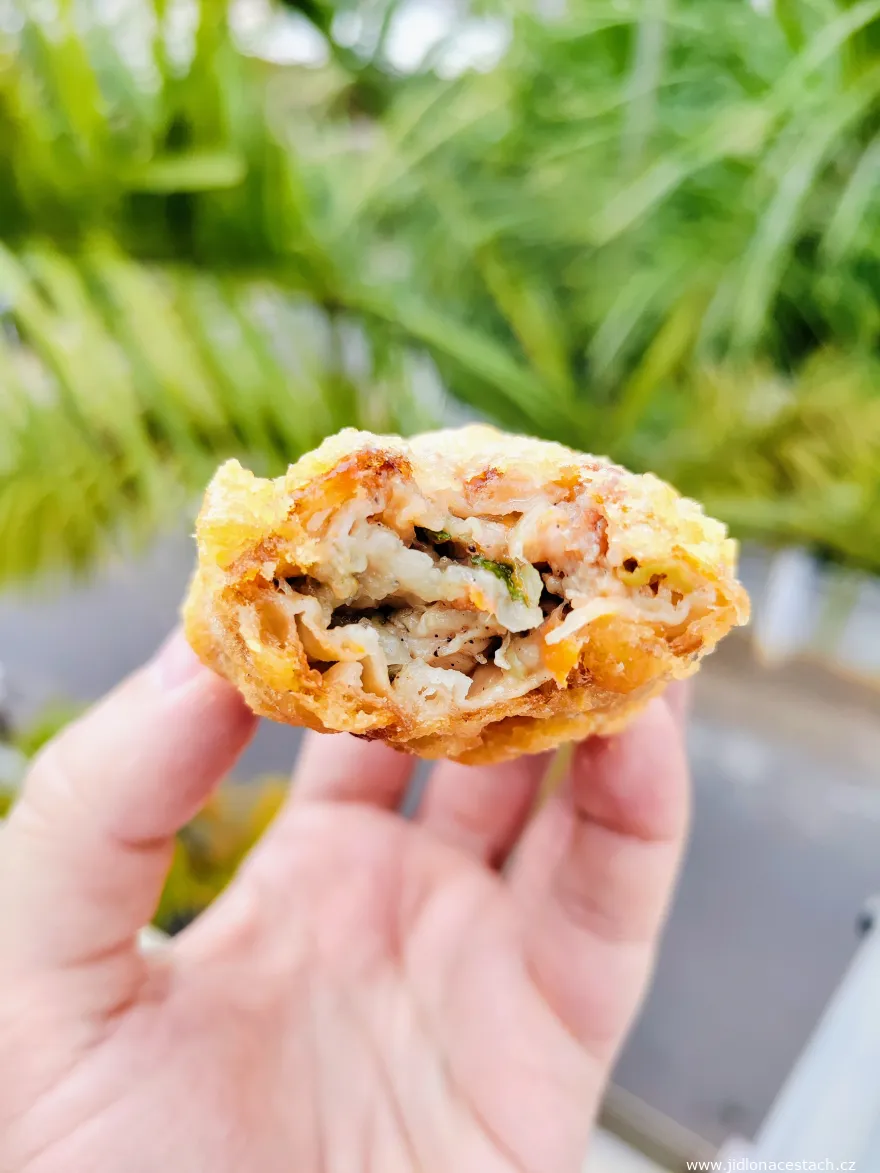
Two Pieces in Flic en Flac
I bought my hakien at Nam Wah Snack in Flic en Flac (see Where to Eat in Flic en Flac), where I ended up more often than anywhere else during my stay, and I ate it right outside, standing up. The crust crunched the way double frying promises, the filling under it stayed moist rather than dry, with more flavors than I'd have expected in such a small roll. A piece cost 40 MUR (0.80 EUR) and two of them easily made a lunch. But you have to go in the morning: more than once I found the hakien sold out before two in the afternoon. I started going earlier.


